
Acting together for sustainable scholar-led publishing. First Swiss Diamond Open Access Conference focuses on sustainability
The organisers of the first Swiss National Diamond Open Access Conference in Bern welcomed participants with croissants and coffee. Under the appealing motto “Acting together for sustainable scholar-led publishing,” the PLATO project invited a specialist audience and experts to the PROGR cultural centre in Bern on 8 March 2024. Dr Daniela Hahn (PLATO, University of Zurich) opened the event and was pleased at the many participants. She praised the Swiss PLATO universities for having jointly succeeded in raising the awareness and visibility of diamond open access, thereby underlining its relevance in the academic community. According to Hahn, the important thing now is to address the problem of sustainability in the area of diamond open access financing and its basic infrastructures.
Status quo: Lots of open access, but hardly any diamond open access
Daniela Hahn then gave the floor to two of her colleagues in the PLATO project, Dr Andrea Malits and Professor Dr Rudolf Mumenthaler, both from the University of Zurich. Based on the study “Mapping the Swiss Landscape of Diamond Open Access Journals” (2023), they reported that many diamond open access journals had to manage with particularly low budgets and that there was a need for more professional advisory services for such journals. One consequence of this was that many diamond open access journals were reliant on volunteer work, which in turn was often an insecure basis for their sustainability. For a visualisation of the status quo of the publication landscape, they referred to the National Journal Monitor, which shows that only 3.6% of the journal articles published in the past five years in Switzerland were published in diamond open access. But still, around 68.5% were published in open access and 31.5% in closed access.
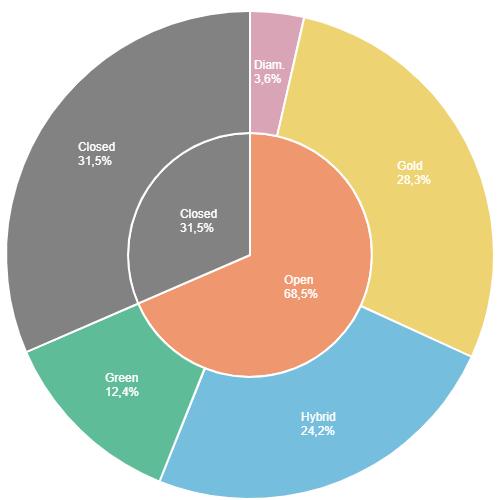
Quelle: Journal Monitor (OAM-CH), aufgerufen am 21.03.2024.
Unfortunately, this result runs counter to the Swiss National Open Access Strategy launched in 2017 with the goal that “by 2024 all scholarly publication activity in Switzerland should be OA and all scholarly publications funded by public money must be freely accessible on the internet". They said that one reason for the difficulty in implementing the strategy was the decentralised Swiss higher education system, which is characterised by federal and cantonal regulations. Future decisions and progress in the area of diamond open access were therefore possible only through superordinate national and international initiatives and community work – here, Malits and Mumenthaler wanted a focus on Swiss learned societies.
No sustainability through inadequate funding
After a short break, Vanessa Proudman (DIAMAS/Director of SPARC Europe/SCOSS Executive Group Chair) presented some insights from her work on the DIAMAS project in the first of three keynotes, entitled "Sustainable Diamond Open Access. What we know so far”. She began by explaining the concept of sustainability, which was the focus of the conference. She pointed out that in addition to long-term financial security, independence and opportunities for development, for example, should also be included and taken into account in the definition of sustainability. The results of the last DIAMAS study had also shown that most diamond open access journals must manage with very little funding and are reliant on volunteers. According to Proudman, university presses have the problem that they must spend a lot of time fundraising. Confirming this finding, a member of the audience said that she needed help with fundraising, because she did not have any time to do it herself. The preconditions that must be met in order to be funded differed depending on the institution, which made the application procedure disparate and thus even more complicated and time-consuming. Vanessa Proudman thanked the participant for her contribution and suggested including it as a case study in the future work at DIAMAS. In addition, she said that there must generally be more permanent public funding for diamond open access in order to enable a certain degree of sustainability. However, one obstacle was that such funding, if it existed at all, was for the most part possible only nationally, which contradicted the very idea of diamond open access – namely, internationalisation. And it was precisely this question of international funding that DIAMAS was pursuing with immediate effect. The seminal report for this, entitled “Into the financial sustainability of IPSPs”, will be published in early April 2024. Proudman said that, complementing this, there would soon be a self-assessment tool for IPSPs, to enable them to assess their own financial sustainability.
Global diamond networking
The problem addressed by Vanessa Proudman relating to the need for international cooperation in the area of diamond open access was then taken up by Pierre Mounier (OPERAS, École des Hautes Études en Sciences Sociales [EHESS]) in the second keynote, entitled “Towards a European Capacity Hub and a Global Federation for Diamond Open Access”. He explained that OPERAS had designed a structure for an international diamond open access hub in collaboration with DIAMAS. The smallest elements in the hub are "communities", which Mounier defined as journals that act as scholarly communities. The next elements in this structure are "capacity centres", which support journals with first-aid measures, for example appropriate advice on tools, services, or training offerings. These capacity centres will in turn be coordinated by "capacity hubs" at continental level. The capacity hubs will have the task of developing joint resources of the capacity centres, organising the exchange of knowledge among the centres, and searching for synergies. This is the structural basis on which the global federation will be built. The global federation will work to promote the diamond open access transformation, support the adaptation of the corresponding open access strategies, and organise a global diamond open access summit. One member of the audience said she was pleased about the project because, based on Mounier's definitions, she could classify her institution as a capacity centre, and she felt that such cooperation in the form of a hub would have considerable advantages for her work.
The third keynote was delivered by Dirk Verdicchio from the University of Bern. Under the title “Building a Diamond Open Access Environment”, he reported the results of his research on the process of creation of diamond open access journals. What was most remarkable was the fact that editorial teams who wished to collaborate with Bern University's publishing platform cared a lot about trust and very little about the technical basis or requirements.
For a sustainable open access future
After the three keynotes there was a lunch break, which was followed in the afternoon by two roundtables. First, Valérie Andres (FHNW Library/Co-President AKOA), Jeanette Frey (Bibliothèque Cantonale et Universitaire Lausanne/Consortium of Swiss Academic Libraries), Beat Immenhauser (Swiss Academies of Arts and Sciences), Tobias Philipp (Swiss National Science Foundation), and Christian Schwarzenegger (swissuniversities) discussed the various initiatives for a sustainable future of scholarly communication. It became clear in the discussion that it was first important to break the rigid cycle of financially based decisions. For if universities were reliant on recruiting renowned researchers, and the prerequisite for reputation continued to be publishing in large commercial journals, universities would be obliged to continue allowing their financial resources to flow to these large publishers. The consequence would be that hardly any budget – or no budget at all – would be left over for open access journals. The roundtable could not imagine a publication future that managed without journals, because a review structure was necessary, which up to now existed only in journal format. In addition, without the quality that this review structure offered, trust in science would be lost. However, Wikipedia was a counterexample where time served as a peer reviewer, as Wikipedia articles were continually being improved and updated in the community over time. In the final round, the experts were each asked to give a concluding statement. Valérie Andres stressed the complexity of the disciplines and the stakeholders, which in turn have different needs for scientific communication initiatives. Beat Immenhauser said that he considered in particular the debate on quality in the area of open access to be worthy of improvement. The assumption that diamond open access articles tended to have quality defects was simply incorrect. Continually focussing on and addressing the alleged quality defects might even strengthen this misconception rather than clearing it up. Jeanette Frey concluded her contribution to the roundtable with a call for reliable funding, which could be ensured, for example, by consortia. However, to be reliable, funding would have to be independent of projects. Christian Schwarzenegger pointed out that it was often difficult to obtain funding in other scientific areas as well, and that it was necessary to live with some uncertainty about the future. In addition, he would like to see a central entry portal for all Swiss publications.
Learning from mistakes and experiences
At the second roundtable, Margit Dellatorre (Zurich University Library/HOPE), Manuel Battegay (President of the Swiss Medical Weekly supporting organisation), Elio Pellin (Bern University Library/CRAFT OA) and Klaus Rummler (PH Zurich/MedienPädagogik – Zeitschrift für Theorie und Praxis der Medienbildung) discussed the topic of “Diamond Open Access Practices: Quality, Efficiency and Sustainability”. They were all agreed that, depending on the discipline in question, different characteristics are important so that a journal can function well. In the area of medicine, the speed with which a journal publishes its articles was an especially important quality characteristic. At this roundtable it was also pointed out that many arguments with which the diamond open access community was confronted were the same as those levelled against closed access or gold open access journals, namely, that they are too expensive, that their quality is questioned, and that their sustainability is doubted. In the final round, the experts could express their wishes for the open access future.
We single out here a comment by Elio Pellin, who expressed the wish that the same mistakes that had already been made in the area of open access would not be made again. The large publishers should not be allowed to continually get their hands on the financial resources for publications. Instead, the funds must be invested in joint European projects. With this look into the future, the first Swiss National Diamond Open Access Conference in Bern came to an end.
Utopia as a motivation
The motto “Acting together for sustainable scholar-led publishing” perfectly sums up the intentions of the project speakers. Sustainability in the area of diamond open access is a pivotal issue both in Switzerland and in Germany, which influences trust in, and thus the establishment of, diamond open access publications. The joint funding of non-commercial publishing venues contradicts the rigid market logics of scholarly publishing, which are based on large scholarly publishers and the bibliometric reputation associated with them. The idea of global networking, which the OPERAS, DIAMAS, and CraftOA projects want to implement jointly, sounds especially promising in this regard, but at the same time also a bit utopian. The goal of the Swiss National Open Access Strategy launched in 2017 – namely, to publish 100% of publications in open access by 2024 – was ambitious. But although this goal has not been fully achieved, the Swiss are at least closer to achieving it. Driving global diamond open access cooperation forward also calls for great ambitions. However, the concrete plans and the motivated open access community in Bern appear to offer good preconditions for this.
Suggested citation
Stork, K. (2024). Acting together for sustainable scholar-led publishing. Erste Schweizer Diamond-Open-Access-Konferenz legt Fokus auf Nachhaltigkeit. open-access.network. doi.org/10.64395/9q4ng-s1y18.
This article is licensed under the Creative Commons Attribution 4.0 International Licence (CC BY 4.0).

Write comment
Comments
No Comments
