Source: Brinken, H. (2021). 10 Reasons for Open Access, open-access.network. https://doi.org/10.5446/51995 (CC BY 3.0 DE)
Authors can make their publications freely available by publishing them open access or by self-archiving them in an open access repository.
When choosing a publication venue, criteria such as thematic focus, quality, and costs should be considered.
When publishing or self-archiving works, authors should be mindful of granting rights of use.
Scholarly Publishing
Only when authors publish their research results do their findings achieve visibility and can thus be adequately recognised and cited. For a long time, publishing works in print media – for example, as journal articles, monographs, or contributions to edited collections – was the most common way of permanently recording and disseminating scientific information.
The possibility of electronic publication, and especially open access, has given rise to a large number of alternative publication options. This significantly increases the citation frequency, and thus also the visibility, of research results (Li et al., 2018; Simard et al., 2022; Swan, 2010). Furthermore, empirical findings show that there are other positive effects, including improved knowledge transfer, greater speed of publication, and increased use by a professionally and geographically diverse readership. At the same time, some frequently voiced reservations towards open access – for example, lower publication quality or disadvantages when selling print editions – cannot be empirically confirmed (Hopf et al., 2022). The aspects that should be considered when publishing open access or when self-archiving in an open access repository are outlined in what follows.
Through their own publishing behaviour, researchers can actively help to shape the shift towards open science communication. The presentation "Open Access unterstützen" [Supporting Open Access] explains how.
Scientists can actively support the change to open science through their own publishing behavior. This practical tip "Supporting Open Access" explains how.
Practical Tip
- What variants of open access publishing are there? Which ones are suitable for me?
- Where can I publish in accordance with the principles of open access? How can I find a suitable journal?
- What do research funders expect?
You can find the answers to these questions in our practical tip: Wo und wie offen publizieren? Eine Einführung in Open Access [Where and How Open to Publish? An Introduction to Open Access].
Practical Tip
The catalogue of services of the project AuROA (Authors and Legal Certainty for Open Access) offers a compilation of possible individual tasks and services in the open access publishing process. AuROA, which ran from 2021 to 2023, addressed the heterogeneous and complex needs, perspectives, and requirements of open access publishing in book-oriented disciplines.
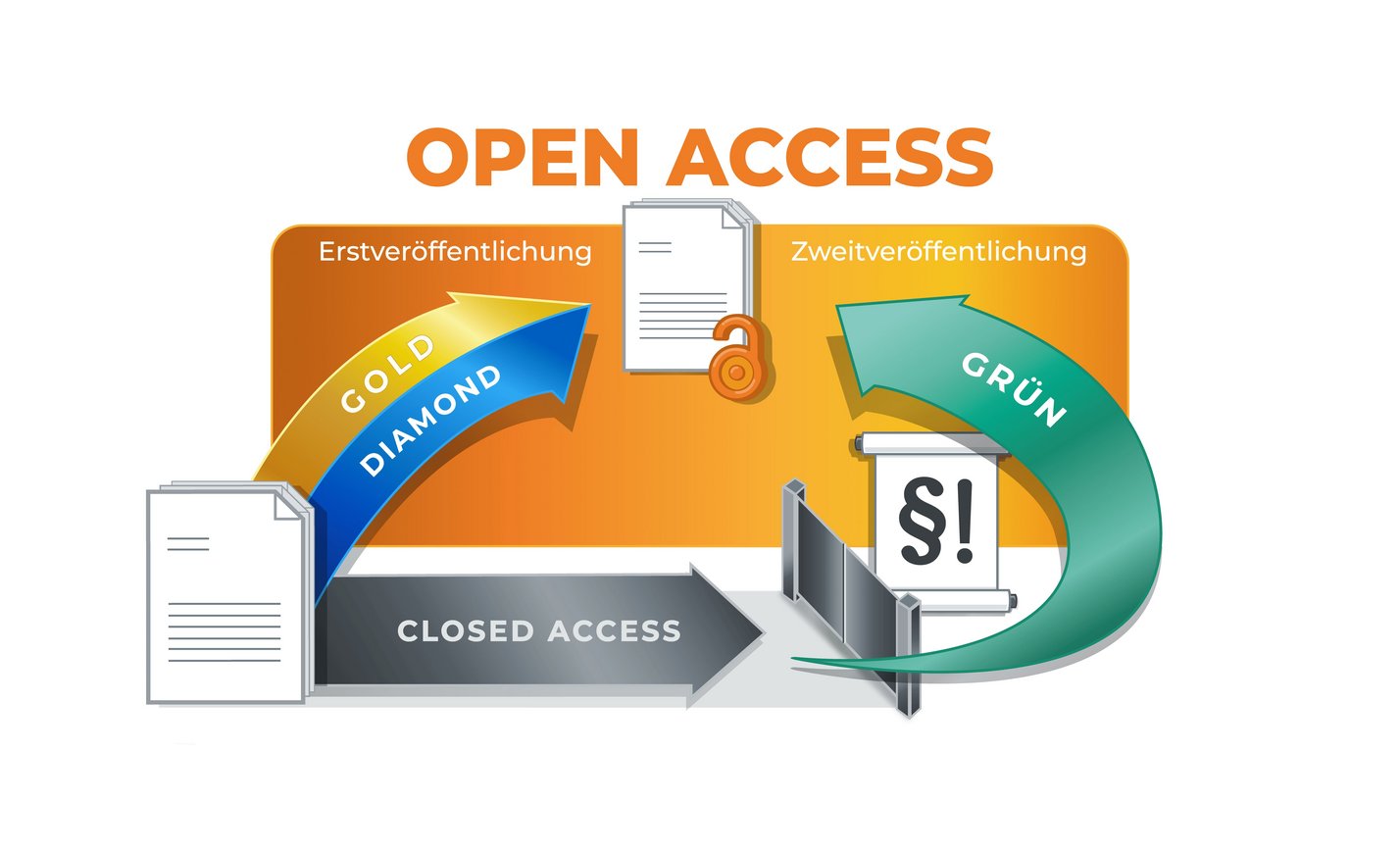
Roads to Open Access
The journey to publication usually begins with the decision as to how the research results should be published. There are many reasons in favour of open access publishing; they are summarised on our Arguments and Reservations page. Basically, two different open access strategies can be distinguished: gold open access and green open access.
Gold open access refers to the publication of scholarly works as articles in open access journals, as open access monographs, or as contributions to open access edited collections or conference proceedings. This literature is freely available and reusable immediately, without an embargo period. One variant of gold open access is diamond open access, where no publication charges arise for authors. You can find more information about diamond open access on our web page Green, Gold, and Diamond Open Access.
Green open access means making research results freely available by self-archiving them in an institutional or disciplinary repository. This can also be done in parallel with or after publication in a journal or with a publisher.
Choosing a Publication Venue
Several parameters play a role when choosing a publication venue. These parameters are largely the same for closed access and open access publications. They include the thematic focus of the venue; the type of quality assurance it employs; its reputation in the field; and, if applicable, the licensing conditions under which the publications are made available and the level of any publication fees that may be charged. The question of what business models and exploitation practices (e.g. user tracking; see Siems, 2022) the authors consider worthy of support may also be relevant when deciding for or against a publication venue.
In the context of open access, research funders’ requirements increasingly play a role. Among funders, one finds not only regulations stipulating that grant holders must provide open access to the scholarly publications arising from funded research, but sometimes also specific requirements with regard to publication venues (Dreher, 2020; Rücknagel, 2021). Further information on research funders’ policies and a list of funding organisations can be found on our Financing page.
Source: Becklas, C., & Hauss, J. (2024): Die Vorteile einer Open Access Dissertation [The Advantages of an Open Access Dissertation]. open-access.network, Leibniz Information Centre for Science and Technology and University Library (TIB) et al. https://doi.org/10.5446/68305#t=00:00,01:15 (CC BY 3.0 DE)

Practical Tip
The following tools may be helpful in finding suitable open access publication venues for your own manuscript:
- oa.finder (a search tool for scholarly publication venues; developed as a project by open-access.network)
- B!SON (a recommender tool for open access journals; developed by Leibniz Information Centre for Science and Technology and University Library (TIB) and the Saxon State and University Library (SLUB) Dresden
- Electronic Journals Library (EZB) (a search tool for open access journals and funding options)
If it is intended to publish a work open access (gold open access), for example, as a journal article, a monograph, or a contribution to a collection, it is advisable to first search for thematically suitable journals or publishers with open access offerings. On our web page Discipline-Specific Open Access, we provide discipline-specific information that can offer helpful introductory pointers. Open access journals can be searched via the Directory of Open Access Journals (DOAJ) or the Electronic Journals Library (EZB). For open access books, the Directory of Open Access Books (DOAB) and the online library and publication platform OAPEN are first ports of call. Suitable publication venues can also be found in conversation with colleagues. If a publisher does not offer a gold open access option, it is often worthwhile enquiring specifically whether it would allow the article to be self-archived in a repository – even without an embargo period.
Open access publications undergo the same quality assurance procedures as traditional publications. The review procedures do not differ either: from classical peer review and editorial review to open review procedures, you can find everything here. The German-language publication Qualitätsstandards für Open-Access-Monografien und -Sammelbände [Quality Standards for Open Access Monographs and Edited Collections] (AG Universitätsverlage, 2018) and AuROA-Leistungskatalog für wissenschaftliche Open-Access-Publikationen [AuROA Catalogue of Services for Scholarly Open Access Publications] (Fadeeva & Graf, 2023) offer guidance in choosing a suitable publisher for open access books. When choosing a journal, the German-language checklist on the quality of open access journals provided by Brinken et al. (2021) can help in assessing its quality. Further information in this regard can be found on our Open Access Journals and Open Access Books pages.
The impact and visibility of scholarly publications play an important role for the reputational gains, and therefore the career prospects, of individual scholars and scientists. Studies show that the citation frequency of open access publications is usually much higher than that of their closed access counterparts. Overviews in this regard are provided by the Open Access Citation Advantage Service and by Piwowar and colleagues’ Large-Scale Analysis of the Prevalence and Impact of Open Access Articles (Piwowar et al., 2018). Journal Impact Factors, a metric of the citation frequency of articles in scholarly journals, are published in the annual publication Journal Citation Reports, which also covers open access journals. An excessive focus on quantitative metrics such as Journal Impact Factors or citation frequency has been criticised for various reasons (American Society for Cell Biology, 2012; Arentoft et al., 2022; Hanson et al., 2024; Hicks et al., 2015). Altmetrics have emerged as an alternative to the traditional bibliometric indicators. They capture the diverse reactions to a scholarly publication on the web. You can find out more about the discussion on qualitative metrics in publications listed in the “Further Reading” section.
In contrast to closed access, where libraries and users pay for access, open access publications are financed in a different way. The author-pays model, whereby authors pay article processing charges (APCs) or book processing charges (BPCs) to have their works published, is very common in the open access context. To find out whether, or what level of, author fees are charged, it is usually helpful to check the website of the journal or publisher. If a journal indexed in the Directory of Open Access Journals (DOAJ) charges APCs, details are deposited in the journal record. However, the majority of open access journals listed in the DOAJ are free of charge both for readers and authors (Morrison, 2018). These journals are financed, for example, by professional societies, academic institutions, library consortia, or – in kind – by voluntary work. For open access books, university presses run by universities or their libraries, and publication media and scholar-led initiatives such as the ScholarLed consortium are an affordable, scholar-led, high-quality alternative to commercial publishers. Detailed information on financing open access articles and books can be found on our Financing page.
Many research institutions have a publication fund from which open access publication fees can be paid. The institution’s library is usually responsible for managing the publication fund. In addition, some open access publishers offer institutional membership, which is similar to a discount model. Institutions pay an annual membership fee, thereby enabling their members to publish their works in the journal in question free of charge or for a reduced fee. Moreover, via transformative agreements with commercial publishers, such as those negotiated by the DEAL Consortium (formerly Projekt DEAL), contractually agreed fees for for the publication of individual hybrid open access articles in subscription journals and APCs for articles in gold open access journals are increasingly covered by library consortia. The funding of genuine open access models by consortia is increasingly coming into focus: the costs are borne by a consortium, and no publication fees are payable by authors, irrespective of whether their institutions participate in the funding.
In addition to funding research, some funding organisations also cover publication costs for articles in scholarly journals and other publications. When submitting a funding proposal to the German Research Foundation (DFG), application can also be made for a publication grant. The Austrian Science Fund (FWF) and the Swiss National Science Foundation (SNSF) have established dedicated funding programmes to finance open access articles and books. The Volkswagen Foundation also covers the publication costs incurred by the projects it funds, and it expects grant recipients to publish open access. International funding organisations, such as the Wellcome Trust, and the EU framework programme Horizon Europe, reimburse publication charges for open access articles as part of their funding. In addition, the Open Access Books Toolkit provides an overview of funding sources for open access books.
Practical Tip
An overview of the requirements that open access journals must fulfil and concrete criteria that authors can use as a guide when choosing a suitable publication venue can be found in the presentation Qualität von OA-Zeitschriften – wo publizieren und wo lieber nicht? [The Quality of OA journals – Where to publish, and where better not to]
Source: Becklas Dorow, C., Hauss, J. (2026). Funding Open Access Articles – What Are the Options?. Technische Informationsbibliothek (TIB), open-access.network. https://doi.org/10.5446/73596 (CC BY 3.0 DE)
Source: Brinken, H. (2020). Finanzierung von Open-Access-Monographien [Funding of Open Access Monographs], open-access.network. https://doi.org/10.5446/49535 (CC BY 3.0 DE)
Self-Archiving (Green Open Access)
It is not always possible to publish open access, for example, when no suitable open access journal is available. A publication can nonetheless be made freely available by self-archiving it in an open access repository. In this way, the author can comply with the open access mandate of a funding organisation or their own institution, and the publication can be made freely accessible to everyone worldwide.
The self-archiving of publications can take place in institutional or disciplinary repositories. The Information for Different Disciplines page lists the repositories available in the respective disciplines. The Open Directory of Open Access Repositories (OpenDOAR) and the Registry of Open Access Repositories (ROAR) also provide overviews. Authors do not have to pay any charges to make their publications available in an institutional or disciplinary repository, nor do readers have to pay to access these publications. What specifically needs to be considered when (self-)archiving can be read by country in our legal section.
Most publishers allow their authors to make their works available in repositories in parallel with publication. The Sherpa Romeo database provides an overview of the open access policies of many journal publishers. Publishers often allow the author’s final version after peer-review (author’s accepted manuscript, AAM) or the published version to be self-archived. Publishing agreements should be drafted in such a way that the authors reserve the right to self-archive their works online in a freely accessible way. Ideally, authors should grant the publisher only non-exclusive rather than exclusive rights of use for the intended types of use. If this is not possible, and no alternative publishing option is available, authors can consider attaching an addendum to the publishing agreement in order to reserve a non-exclusive right to use the work online in a repository. Various possible solutions to this problem are available on the Publishing Agreements page.
Under Section 38 of the German Act on Copyright and Related Rights (UrhG), authors of scientific contributions that result from research activities at least half of which were financed by public funds, and that were published in a collection that appears periodically at least twice a year, have the right to self-archive them in an open access repository upon expiry of 12 months after publication. According to this statutory provision on self-archiving, it is therefore possible in these cases to make these works available in a repository even if the publishers have been granted exclusive rights of use (Brehm, 2021). A German-language guide issued by the Communication, Information, Media Centre (KIM) at the University of Konstanz provides an overview of the topic of self-archiving.
Self-archiving is easier when a work is published in an open access journal or with an open access publisher. As a rule, they allow the work to also be made available in a repository provided the place of publication is credited.
Source: Brinken, H., Hauss, J. & Rücknagel, J. (2021). Wie genau funktionieren Creative-Commons-Lizenzen? [How exactly do Creative Commons licences work?] open-access.network. https://doi.org/10.5446/52952 (CC BY 3.0 DE)

Authors who wish to make their works available in open access should observe several legal requirements. Of central importance is that the authors themselves have the right to exploit their works online. However, this is not necessarily a given in standard publishing agreements. An overview of the legal situation in Germany, Austria, and Switzerland can be found on our Legal Issues page, which provides information on copyright, making documents available in repositories, publishing agreements, licences, liability law, and data protection.
Open Access Licences
One important aspect of open access is the reuse of publications. In order to make it clear what rights third parties have when (re-)using research results, user licences are granted. It is up to the authors themselves to decide what degree of freedom of use of their works they wish to allow. It is recommended that authors allow a free worldwide right of access to and reuse of their publications.
The granting of open licences by authors should take place in consultation with the respective publishers or, if applicable, in compliance with the repositories’ licensing requirements. In the area of science and research, the open Creative Commons (CC) licences are the most common.
An overview of various open content licensing models can be found on our Licences page. The use of licences to grant specific rights of use facilitates law enforcement in the case of misuse and gives users explicit instructions on how the document in question may be reused. At the same time, if authors wish to allow additional uses, they retain the possibility to conclude separate agreements.
Predatory Journals
Unfortunately there are also journals that operate the article processing charge (APC) model in a manner detrimental to science. These predatory journals, which are founded by predatory publishers, try – sometimes massively – to attract researchers to publish in their journals. However, they do not observe the usual standards of good scientific practice. Hence, there is no quality assurance, for example in the form of peer review, nor is there adequate editing.
As a result, predatory journals damage science and scholarship because they also publish substandard contributions whose compliance with academic or ethical standards has not been checked. As publications in these dubious journals can cause substantial reputational damage, researchers are urgently advised against submitting manuscripts to them.

Practical Tip
Recongnising Predatory Journals
It is not always easy for authors to recognise whether a journal is predatory or not, because the providers often go to a lot of trouble to make their journals appear trustworthy. On professional-looking websites, sometimes entire editorial boards are given false names, or well-known researchers are listed as editors, without their knowledge.
The German-language checklist on the quality of open access journals provided by Brinken et al. (2021) can help authors to make informed decisions. Other criteria for the assessment of the trustworthiness of a journal are provided by the website Think. Check. Submit. It can also be helpful to ask colleagues whether they have ever heard of the journal in question. In case of suspicion, attention should definitely be drawn to the journal. By keeping their eyes open and having the right awareness, authors can avoid publishing with predatory publishers by mistake.
Maxl and Ferus (2023) provide a detailed overview of the topic of predatory publishing and predatory publishers, including examples, checklists, etc.
A similar threat to the quality of open access journals comes from paper mills. This term refers to commercially motivated service providers that write substandard or even fake articles and then sell authorship to scientists. Due to a flood of submissions of low-quality articles, scholarly journals’ peer-review processes come under pressure, so that quality assurance can ultimately be maintained only to a limited extent (Chambers, 2024). This problem is exacerbated by the use of artificial intelligence to generate texts (Naddaf, 2025). However, many publishers are taking countermeasures to protect themselves against such violations of good research practice. These measures include, for example, the development of tools to recognise suspicious manuscripts and the coordination of initiatives such as the United2Act or the STM Integrity Hub.
Further information on predatory journals and predatory publishers can be found in an overview provided by Helmholtz Open Science and in a German-language fact sheet published by the Science Media Center Germany. In addition, there is a catalogue of criteria for recognising high-quality journals and so-called fake journals. Furthermore, the Monash Health Library has published a useful overview entitled Predatory Publishing A-Z Elements (reproduced above).
References
- AG Universitätsverlage. (2018, September 11). Qualitätsstandards für Open-Access-Monografien und -Sammelbände. https://ag-univerlage.de/?p=1974
- American Society for Cell Biology (2012). San Francisco Declaration on Research Assessment (DORA). https://sfdora.org
- Arentoft, M., Berghmans, S., Borrell-Damian, L., Bottaro, S., Faure, J.-E., Gaillard, V., Glinos, K., Albacete, J. L., Morais, R., Morris, J., Schiltz, M., & Stroobants, K. (2022). Agreement on Reforming Research Assessment. https://doi.org/10.5281/zenodo.13480728
- Brehm, E. (2021). Zweitveröffentlichungsrecht für Wissenschaftler*innen. https://doi.org/10.5446/51789
- Brinken, H., Rücknagel, J., & Wenninger, A. (2021). Checkliste zur Qualität von Open-Access-Zeitschriften. Zenodo. http://doi.org/10.5281/zenodo.4643853
- Chambers, H. (2024). Unmasking the fraud: How paper mills are undermining scientific publishing. Developmental Medicine and Child Neurology, 66(10), 1262–1263. https://doi.org/10.1111/dmcn.15997
- Dreher, L. (2020, August 27). Open-Access-Vorgaben in EU-Projekten. OpenAccessTalk. http://doi.org/10.5281/zenodo.4048489
- Fadeeva, Y. & Graf, D. (2023). AuROA-Leistungskatalog für wissenschaftliche Open-Access-Publikationen. Transparente Aufstellung von Aufgaben für Buchpublikationen (Version 2.0). Zenodo. https://doi.org/10.5281/zenodo.7766175
- Hanson, M. A., Gómez Barreiro, P., Crosetto, P., & Brockington, D. (2024). The strain on scientific publishing. Quantitative Science Studies, 5(4), 823–843. https://doi.org/10.1162/qss_a_00327
- Hicks, D., Wouters, P., Waltman, L., de Rijcke, S., Rafols, I (2015). Bibliometrics: The Leiden Manifesto for research metrics. Nature 520, 429–431. https://doi.org/10.1038/520429a
- Hopf, D., Dellmann, S., Hauschke, C., & Tullney, M. (2022). Wirkungen von Open Access. Literaturstudie über empirische Arbeiten 2010-2021. Technische Informationsbibliothek (TIB). https://doi.org/10.34657/7666
- Li, Y., Wu, C., Yan, E., & Li, K. (2018). Will open access increase journal CiteScores? An empirical investigation over multiple disciplines. PLOS ONE, 13(8), e0201885. https://doi.org/10.1371/journal.pone.0201885
- Maxl, G., & Ferus, A. (2023, June 6). Predatory und andere fragwürdige Praktiken in der wissenschaftlichen Kommunikation. Open Access Talk. https://doi.org/10.5281/zenodo.8010590
- Morrison, H. (2018, January 31). DOAJ APC information as of Jan 31, 2018. Sustaining the Knowledge Commons / Soutenir Les Savoirs Communs. Open Access Scholarship / Littérature Savante En Libre Accès. https://sustainingknowledgecommons.org/2018/02/06/doaj-apc-information-as-of-jan-31-2018/
- Naddaf, M. (2025, September 23). Journals infiltrated with ‘copycat’ papers that can be written by AI. Nature. https://doi.org/10.1038/d41586-025-03046-z
- Piwowar, H., Priem, J., Larivière, V., Alperin, J. P., Matthias, L., Norlander, B., Farley, A., West, J., & Haustein, S. (2018). The state of OA: A large-scale analysis of the prevalence and impact of Open Access articles. PeerJ, 6, e4375. https://doi.org/10.7717/peerj.4375
- Rücknagel, J. (2021, April 15). Fördererauflagen zu Open Access - was gilt es zu beachten? OpenAccessTalk. http://doi.org/10.5281/zenodo.4694320
- Siems, R. (2022). Das Lesen der Anderen: Die Auswirkungen von User Tracking auf Bibliotheken. O-bib, 9(1), 1–25. https://doi.org/10.5282/o-bib/5797
- Simard M-A, Ghiasi G, Mongeon P, Larivière V (2022) National differences in dissemination and use of open access literature. PLoS ONE 17(8), e0272730. https://doi.org/10.1371/journal.pone.0272730
- Swan, A. (2010). The Open Access citation advantage: Studies and results to date. https://eprints.soton.ac.uk/268516/
Further Reading
- Crotty, D. (2023, October). Quantifying consolidation in the scholarly journals market. The Scholarly Kitchen. https://scholarlykitchen.sspnet.org/2023/10/30/quantifying-consolidation-in-the-scholarly-journals-market/
- Forschungszentrum Jülich, Zentralbibliothek. (2022). Predatory Publishers. "Schwarze Schafe" im Wissenschaftsbetrieb. Checkliste. https://www.fz-juelich.de/de/zb/open-science/predatory-publishers
- Holzer, A. (2022). Die Vermessbarkeit der Wissenschaft: Digitalisierung, wissenschaftliches Publizieren, Verhaltenstracking und Wissenschaftsbewertung. In N. Mößner & K. Erlach (Eds.), Kalibrierung der Wissenschaft: Auswirkungen der Digitalisierung auf die wissenschaftliche Erkenntnis (Science Studies). Transcript Verlag. https://doi.org/10.14361/9783839462102
- Ioannidis, J. P. A., Collins, T. A., & Baas, J. (2024). Evolving patterns of extreme publishing behavior across science. Scientometrics, 129(9), 5783–5796. https://doi.org/10.1007/s11192-024-05117-w
- Ma, L. (2022). Metrics and epistemic injustice. Journal of Documentation, 78(7), 392–404. https://doi.org/10.1108/JD-12-2021-0240
- Reimer N., & Halbherr, V. (2021). Kriterienkatalog zur Erkennung von qualitativ hochwertigen Journals und von sogenannten Fake-Journals. Zenodo. https://doi.org/10.5281/zenodo.5031928
- Retzlaff, E. (2022). Wer bewertet mit welchen Interessen wissenschaftliche Publikationen? Eine Skizzierung des Einflusses kommerzieller Interessen auf die Forschungsoutput-Bewertung. In N. Mößner & K. Erlach (Eds.), Kalibrierung der Wissenschaft: Auswirkungen der Digitalisierung auf die wissenschaftliche Erkenntnis (Science Studies). Transcript Verlag. https://doi.org/10.14361/9783839462102
- Schmitz, J., & Schmeja, S. (2019). Bericht zum Workshop "Was tun, wenn es passiert ist? Umgang mit Publikationen, die bei einem Predatory Journal eingereicht wurden." https://doi.org/10.5281/zenodo.3553616
- Solomon, D. J., & Björk, B.-C. (2012). A study of open access journals using article processing charges. Journal of the American Society for Information Science and Technology, 63(8), 1485–1495. https://doi.org/10.1002/asi.22673