
On 5 May 2026, open-access.network, a project funded by the German Federal Ministry of Research, Technology and Space (BMFTR), offered an introductory workshop on open access within the framework of the Heinrich Böll Foundation’s PhD Candidates’ Forum. The workshop met with great interest.
With this workshop, the project open-access.network collaborated for the first time with the talent development programme of a political foundation to raise awareness of the topics of open access and open science among early career researchers. At the annual PhD Candidates’ Forum, the Heinrich Böll Foundation’s PhD scholars present their research projects and discuss science policy topics. The motto of this year’s three-day event at the Foundation’s Berlin office was “Scientists between Neutrality and Activism – May or Must Science be Political? Entitled “Between Career Pressure and Political Aspirations: How do We Create Equitable Publishing Structures?”, the workshop was devoted to the structural and socio-political aspects of open access, scholarly publishing, and research evaluation practices, and reflected the field of tension in which many PhD candidates find themselves.
In the run-up to the event, it became apparent that the approach of placing the socio-political dimension of open access centre stage had struck a chord: Well over half of the Forum participants chose the open-access.network offering over other concurrent sessions. As the workshop facilitator, I was delighted about the great interest shown. Researchers are generally one of the target groups that the open access community often finds it more difficult to reach. The PhD candidates’ great interest and active participation could be interpreted as encouragement to also incorporate the political clout of open access and debates about reputation and the scholarly publishing system more often and to a greater degree into the introductory workshops on open access.
An Interdisciplinary Group with Political Awareness
The 27 workshop participants were from different disciplines and had travelled to Berlin from various cities in the German-speaking area.
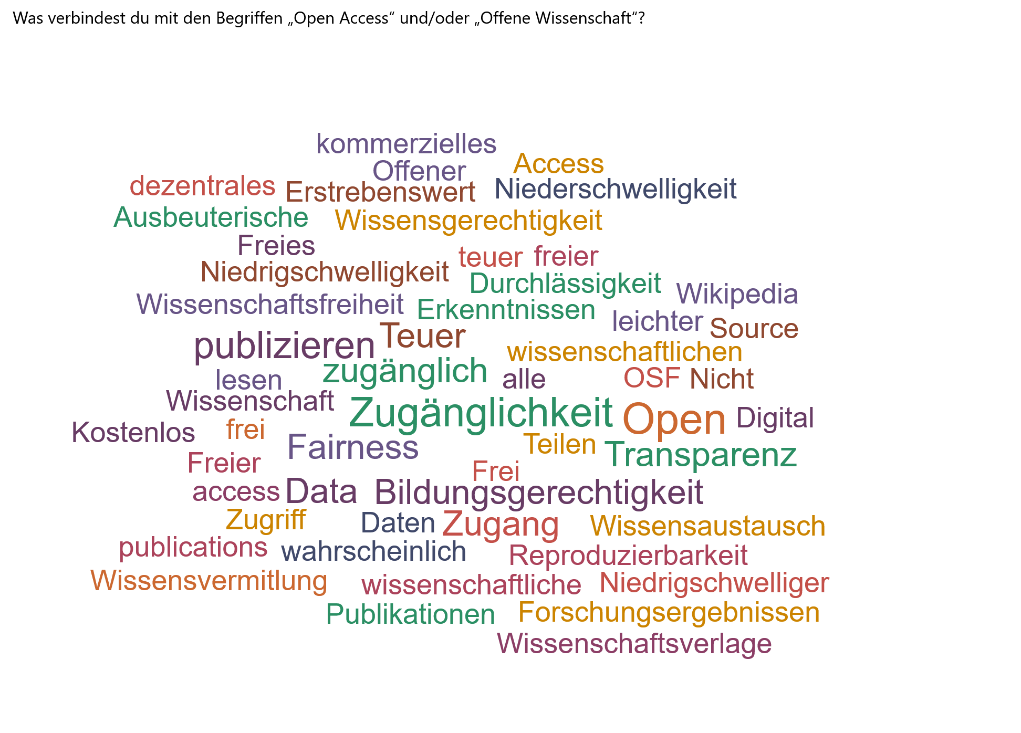
The level of knowledge about open access within the group was quite heterogeneous. A quick poll by show of hands showed that most of the group already had points of contact with open access. But for some participants, the topic was new. However, the first interactive activity showed that the participants were highly motivated and politically aware and that they applied their committed perspectives to the topic of open access. In response to a survey question asking: “What do you associate with the terms ‘open access/open science’?”, topics such as “educational equity”, “knowledge equity”, “fairness”, “accessibility”, and “exploitative scholarly publishers” were mentioned – even before they were discussed in depth at the workshop.
Part 1: Fundamentals and Socio-Political Dimension of Open Access
As not all participants were familiar with open access, the workshop began with compact input on the fundamentals. This was followed by the first small-group phase, in which the participants discussed the relevance of open access from the perspective of various personas. Here, the workshop material "Und Du? Warum ist Open Access für Dich wichtig?" [And you? Why is open access important for you?] (Schicketanz, 2026) was used. In the discussions, the participants developed application examples and talked about their own experiences.
The conversations were so intensive that the 15-minute small-group discussion could easily have lasted twice as long. In the subsequent plenary session, participants cited the capital interests of the major publishers as a key obstacle to open access. One of the first comments came from a person who had not engaged with the topic of open access before and who asked why open access had not yet become the norm if the advantages were that obvious. Other participants immediately pointed out the power of the major publishers. The group regarded the societal relevance of open access as obvious. At the same time, the participants stressed that a broader view should be taken of open access. For example, that it would be desirable to write research results and scientific texts in such a way that they are understandable – and therefore accessible – to more people. By way of example, the practice in psychology was mentioned, whereby studies are prefaced with a lay summary, in which research results are presented in a brief, jargon-free text.
A further key issue was the monopoly position of the major publishers, which was identified as a problem and a further reason why diamond open access, in particular, was necessary. In addition, possibilities of gaining access to literature without being enrolled at a university were discussed. Here, it was clear how cut off and disadvantaged those without institutional access feel. In this connection, one of the participants recalled her time as a legal trainee after finishing university, when her lack of university membership meant that she had hardly any access to specialist literature. Global inequality due to unequal access to scholarly publications was also addressed by the participants. In addition, multilingualism was mentioned as an advantage of open access, as it enables access to scholarly publications in various languages. The free and, in particular, digital worldwide accessibility of these texts makes them more easily reachable.
Overall, it became apparent that the socio-political relevance of open access in particular and open science in general was clearly recognised in the group. Besides the scenarios outlined in the discussion on the relevance of open access from the perspective of various personas, the participants brought up many other fields and identified the socio-political importance of free access to scholarly literature. As the group was in agreement on this, the workshop could move on a little sooner to the second part, which had been explicitly requested once again during the round of introductions.
Part 2: Career Pressure, Publishing Decisions, and Research Evaluation –Everyday Life as a PhD Candidate
The second part of the workshop was explicitly devoted to the participants’ own publishing decisions and their political and career implications. As the workshop facilitator, I put forward the following argument, which the participants once again discussed animatedly in small groups:
Because of career pressure, the pressure to publish as much as possible or in the most high-ranking journals possible, I don’t have the time to reflect on overarching questions about science policy and publishing culture.
In the subsequent plenary discussion, it became clear that especially early career researchers doing a cumulative doctorate are under particular career pressure. One participant noted in relation to the opening argument that he actually did have enough time to reflect on where to publish and that he would like to publish everything open access. At the same time, he was only a small cog that couldn’t change anything on its own anyway. In this connection, the Impact Factor and the ranking of journals in general were mentioned. Some participants pointed out that they had to publish in specific high-impact journals in order to obtain their doctorate or get a good job later. The rigid structures in academia were described as restrictive, and several participants confirmed the aforementioned career pressure. The participants described doctoral training as very challenging and demanding. As one participant put it:
You’re already overwhelmed by everything when you’re doing your PhD, and it takes a lot of time and effort to acquire knowledge, a critical perspective on structures, and an attitude to publishing.
A discussion developed about the field of tension between criticism of individuals and criticism of the system. Not all participants agreed with the statement that as an individual, there’s nothing you can do. Nonetheless, the position soon became clear that political lobbying was important for open access. In this connection, the support of independent, small, possibly collectively organised open access publishers was mentioned and the fact that universities are the best anchors for such publishers.
Conclusion: A Workshop with an Echo
The workshop showed that open access touches the core issues of scientific practice and has a clear political dimension and societal relevance. That this debate was conducted with politically committed early career researchers is an important step towards taking open access topics out of the library and infrastructure community bubble. The Heinrich Böll Foundation has already expressed interest in developing the collaboration.
As takeaways from the workshop, the following three key insights can be formulated:
- The early career researchers are politically aware: The participants contributed their own perspectives and showed that, for them, open access is not an abstract concept but rather a concrete demand for social participation and the accessibility of knowledge.
- Career pressure vs. idealism: The tension between individual constraints and collective change was clearly evident. Here, the group saw room for manoeuvre through joint demands or the support of alternative publishing models.
- Out of the open access bubble: This workshop marked the first time that open-access.network created an offering on the subject of open access for PhD scholars from a political foundation. That it was so well received underscores the necessity to take open access debates into political contexts.
References and Links for Further Reading
- Materials for open access workshops provided by the German National Library of Science and Technology (TIB): Schicketanz, K. (2026, February 16). "Und Du? Warum ist Open Access für Dich wichtig?" – Material für einen Präsenz-Workshop zum Thema Open Access [“And you? Why is open access important for you?” Material for an in-person workshop on open access]. German National Library of Science and Technology (TIB) Hannover. https://doi.org/10.5281/zenodo.18655342
- Heinrich Böll Foundation. (n.d.). Promotion funding. https://www.boell.de/en/promotion-funding
Suggested Citation
Weinberg, L. (2026): Between Career Pressure and Political Demands: How Do We Create Equitable Publishing Structures? open-access.network. DOI: 10.64395/mekj9-ncs63
This post is licensed under the Creative Commons Attribution 4.0 International License (CC BY 4.0).

