
Open Access in Mathematics
In contrast to their peers in many natural science or technical disciplines, mathematicians still draw on older literature when investigating current research questions. Open access in mathematics is therefore not restricted to current research results but also includes older literature. Retrodigitisation and open access to this digital content thus play an important role in this discipline.
Another difference between mathematics and most natural science disciplines is the acceptance of literature that has not undergone scientific quality control. For example, in 2006, Grigori Yakovlevich Perelman was awarded the Fields Medal for a series of three papers proving the Poincaré conjecture, which he had published only on the preprint server arXiv. Because these papers were published open access, Perelman’s proof could be checked by various groups, even without undergoing classical peer review.
Mathematicians are highly critical of rising journal prices. Thus, it is not surprising that in this field in particular, researchers often call for, and also participate in, boycotts of scholarly publishers (e.g. The Cost of Knowledge).
Open Access Journals
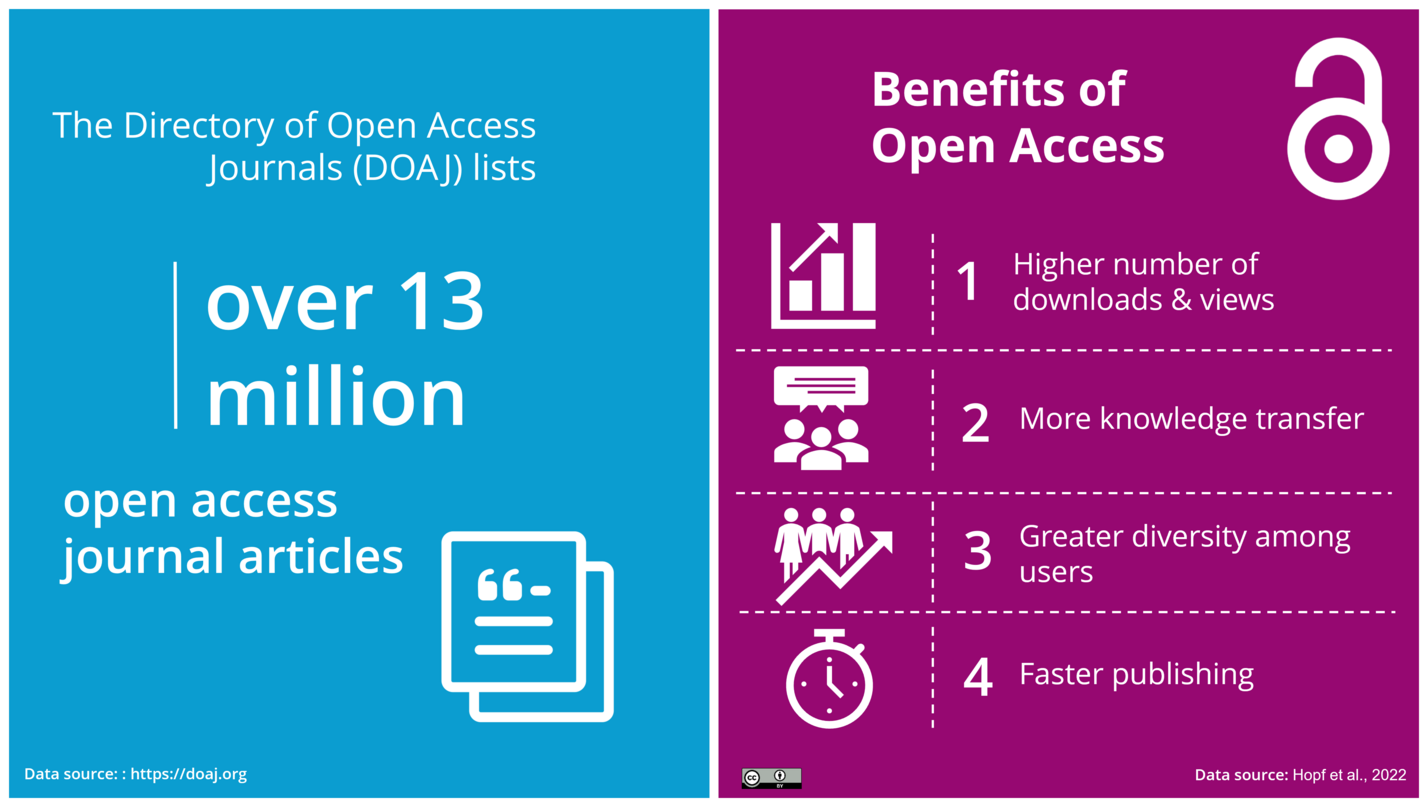
As of November 2025, the Directory of Open Access Journals (DOAJ) listed 815 entries under Mathematics.
Article processing charges (APCs) are often viewed critically. For this reason, open access mathematics journals often use business models without APCs. Many of these journals are published directly by scientific institutions or professional associations.
Examples include:
Because, as mentioned above, older literature is of great importance in mathematics, older journal volumes are often made freely available online even if the current volumes are closed access and thus subject to a fee. In these cases, the moving- wall model is often used: for a certain period of time (e.g. the first five years after publication) access is fee-based; after expiry of this embargo period, access is free.
When publishing works in open access journals, care should be taken – also in mathematics – to avoid predatory publishing.
Source: Becklas Dorow, C., Hauss, J. (2026). Funding Open Access Articles – What Are the Options?. Technische Informationsbibliothek (TIB), open-access.network. https://doi.org/10.5446/73596 (CC BY 3.0 DE)
Open Access Books
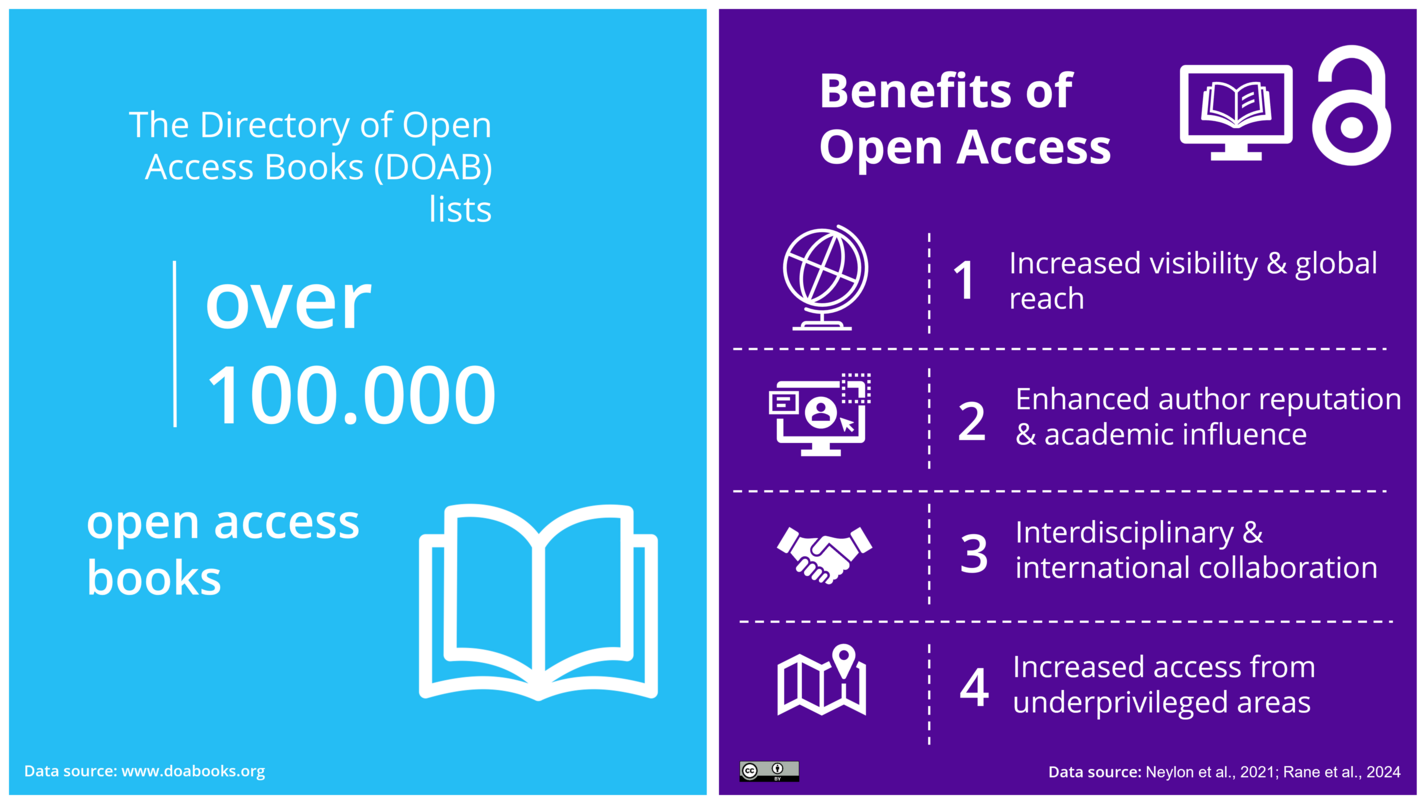
As of November 2025, the Directory of Open Access Books (DOAB) listed 95 titles under “Mathematics“ and 207 titles under “Mathematics & science“, while OAPEN listed around 70 titles under “Mathematics“.
Most books in mathematics are published with publishers that have traditional business models, and open access books are still a peripheral phenomenon.
Disciplinary Repositories
The most important repository in mathematics is arXiv, a preprint server for physics, mathematics, and related disciplines (see our Physics page). As arXiv grew in importance, the once-longstanding practice whereby authors published their preprints on their institutions’ websites was abandoned. Many repositories in mathematics no longer publish any new preprints (one exception: the Max Planck Institute for Mathematics’ MPIM Preprint series).
Mathematics research data can be conveniently deposited in Zenodo or in disciplinary repositories, which can be found, for example in the Registry of Research Data Repositories, re3data.
In addition, there are a number of open access repositories with retrodigitised mathematics literature, the most important of which are:
- Göttinger Digitalisierungszentrum (GDZ): contains, among other things, theCollection Mathematica, in which the Göttingen State and University Library’s entire historical mathematics collection up to and including the year 1900 is made accessible.
- NUMDAM: is located at the Université Grenoble Alpes and contains many French and Italian journals. Although access is free, embargo periods vary from journal to journal.
- The University of Michigan Historical Mathematics Collection: contains monographs published in the 19th and early 20th centuries.
- Historical Math Monographs (Cornell University Library)
- Project Euclid (Cornell University): hosts e-journals, many of which are open access.
The Open Directory of Open Access Repositories (OpenDOAR) provides an overview of these and other repositories.
Video über das Zeitveröffentlichungsrecht
Quelle: Brehm, E. (2021). Zweitveröffentlichungsrecht für Wissenschaftler*innen, open-access.network. https://doi.org/10.5446/51789 (CC BY 3.0 DE)
Practical Tip
Finding Open Access Literature (in German)
Other Useful Offerings
The information platform zbMATH OPEN (formerly known as Zentralblatt MATH) has been open access since 2021. Open and reusable interfaces ensure the networking and sharing of scientific information. The goal is to establish the platform as a crucial hub in an open global mathematics library.
The European Digital Mathematics Library (EuDML) is another open access research tool.
Furthermore, within the framework of the Committee on Electronic Information and Communication (CEIC) of the International Mathematical Union (IMU), efforts are being made to develop a World Digital Mathematics Library (WDML)in which the entire mathematics literature would be indexed, interlinked, and made accessible and reusable in the long term. zbMATH OPEN is a first step in this direction.
To ensure the scientific quality of open access articles, the Episciences project provides a free platform on which contributions can undergo peer review. In this way, articles deposited in arXiv can undergo scientific quality control.
Open Science in Mathematics
Mathematical methods are also increasingly being applied successfully in interdisciplinary research and are therefore widespread. For example, mathematical models, parameters, data, and numerical algorithms are used in machine learning. Mathematical research data have thus become very complex, multifaceted, and unwieldy. The publication of these resources in open access is therefore highly beneficial for interdisciplinary research. However, especially in the area of data sciences, huge computing capacity is sometimes required (see the Mathematical Research Data Initiative, MaRDI, 2021).
Traditionally, proving theorems is a central element of the publishing culture in mathematics. These proofs must be completely understandable to readers within the contribution itself. In open access publications, all content is already freely available. For a long time, there was therefore no need to provide supplementary research data. However, as digitalisation advances, automated theorem-proving procedures, visualisations, and other types of mathematical research data are increasingly emerging, and the open accessibility of these resources is becoming more and more important.
Mathematical research data are very complex and diverse. The MaRDI Knowledge Graph, which is currently being developed, links many open access sources of mathematical research data. Besides the Knowledge Graph, other research data services tailored to the mathematics community can be found on the MaRDI Portal.
Software developed in mathematics is often versioned and made available via Github, which has been part of Microsoft since 2018. Public GitHub repositories can be accessed without prior registration. However, to upload one’s own data, registration is necessary; the basic functions of the service are available free of charge. Many universities and research institutes offer Git instances of their own, based, for example, on the open source platform GitLab.
Some journals that cover the computationally intensive areas of mathematics, for example numerics, already check the reproducibility of the code and software components of papers. One example is Computational Science and Engineering, a gold open access journal with its own Code Review Board. Efforts are being made to extend this to other areas of mathematics.

Further Reading
- Boege, T., Fritze, R., Görgen, C., Hanselman, J., Iglezakis, D., Kastner, L., Koprucki, T., Krause, T., Lehrenfeld, C., Polla, S., Reidelbach, M., Riedel, C., Saak, J., Schembera, B., Tabelow, K., & Weber, M. (2022). Research-data management planning in the German mathematical community [Preprint]. arXiv. https://arxiv.org/pdf/2211.12071
- Das, P. K. (2017). Anatomy of open access mathematics journals. Journal of Information and Knowledge, 53(6), 447–454. https://doi.org/10.17821/srels/2016/v53i6/98585
- Hanselman, J. (2025). Guidelines for writing and reviewing mathematical software. Notices of the AMS. https://www.ams.org/journals/notices/202507/noti3210/noti3210.html
- Taubert, N. (2021). Green open access in astronomy and mathematics: The complementarity of routines among authors and readers. Minerva, 59, 173–194. https://doi.org/10.1007/s11024-020-09424-3
- Teschke, O. (2018, December). Green, gold, platinum, nickel: On the status of open access in mathematics. EMS Newsletter. https://ems.press/content/serial-article-files/10613?nt=1
Content editor of this page: Dr Gernot Deinzer, Regensburg University Library.
Last revision of content: Tabea Bacher, Max Planck Institute for Mathematics in the Sciences (MPI MiS), with the kind support of Britta Schneemann, MPI MiS (as of November 2025).