
Open Access in Medicine and Life Sciences
In medicine and the life sciences, open access is particularly supported by mandates from research funders such as the National Institutes of Health (NIH), the Wellcome Trust, and the Bill & Melinda Gates Foundation. Calls for free access to the results of research in medicine and the life sciences point to the direct link between open access and public health, especially in the Global South. Consequently, the World Health Organization (WHO) is also committed to promoting open access to the results of medical research; it operates IRIS, a repository for the sharing of health-related information. Some research funders also provide publishing platforms on which the results of the research that they fund can be published. Examples of such platforms include Wellcome Open Research and Gates Open Research. To comply with funding requirements, the published results of NIH-funded research must be made accessible on PubMed Central (PMC), the disciplinary repository for biomedical and life sciences journal literature at the NIH National Library of Medicine.
Many of the open access journals in the life sciences that were founded in the 2010s are now well established. Journals such as PeerJ, BMJ Open, Cell Reports, and eLife focus exclusively on this domain.
In addition, since around 2016, preprint servers have increasingly played a role in making the results of research in medicine and the life sciences available in open access at an early stage. They include, for example, bioRxiv and medRxiv, which have a life science focus (further preprint servers can be found in the preprint server directory provided by ASAPbio). During the COVID-19 pandemic, preprints in medicine gained increased importance for the rapid dissemination of research results. However, criticism of the publication of preprints was also voiced, because results were available before undergoing quality control through peer review and the media picked up these unreviewed results and treated them as scientific facts
The infiltration of the state of the art in medicine and the life sciences by predatory publishing – especially journal hijacking (Hegedűs et al., 2024), indexjacking (Abalkina, 2024), and paper mills (Abalkina, 2023) – is proving increasingly problematic. According to estimates, around 3% of the articles published in medicine and the life sciences originate from paper mills (Van Noorden, 2023). Due to these phenomena, it is becoming more and more difficult to filter out scientifically valid results for review articles and evidence syntheses. As a result, medical treatments may become ineffective, or even dangerous (Chambers, 2024). Thus, in view of the existence of predatory publishing and hijacked journals, particular prudence is necessary. If you are unsure about the reliability of a journal, it is advisable to consult checklists such as Think.Check.Submit or to check whether the journal may have been hijacked. When it comes to paper mills, editors and publishers in particular must be vigilant to avoid being overrun by mass submissions of inferior quality. At the publisher level, there are now several initiatives such as United2Act and STM Integrity Hub that are dedicated to combatting the problem and filtering out such submissions by technical means even before the peer-review stage.
Open Access Journals
As of April 2024, the Directory of Open Access Journals (DOAJ) listed 4,462 indexed journals under the subject category "Medicine" alone, of which over 581 had been awarded the DOAJ Seal.
The journal list on the PubMed Central platform also offers search possibilities. Versions of articles from certain journals are available free of charge immediately upon publication or after an embargo period or are available in open access under a Creative Commons licence.
The Electronic Journals Library (EZB) provides information on the open access status of journals in medicine and the life sciences.
Open Access Books
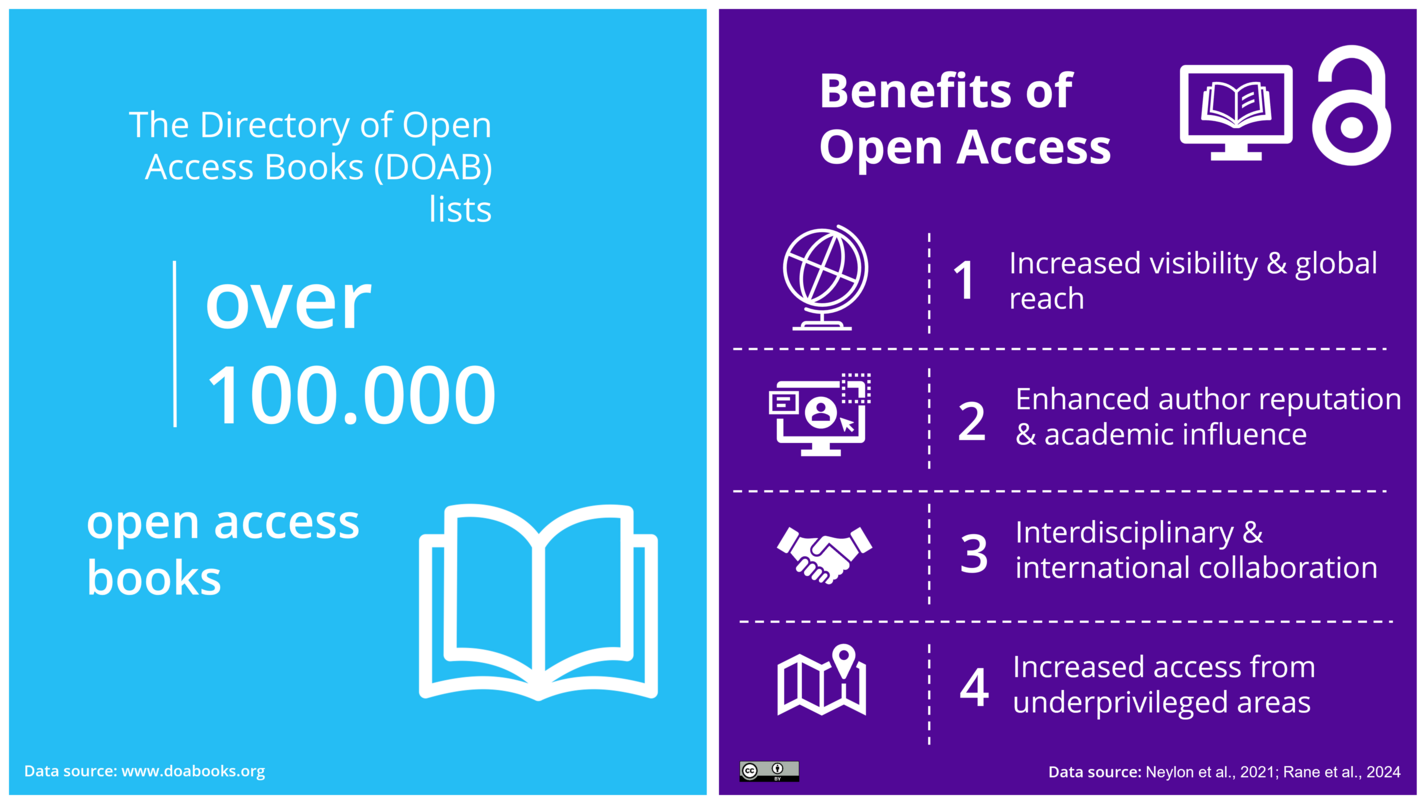
As of April 2024, the Directory of Open Access Books (DOAB) listed over 11,399 titles under the search string "Life Science" OR Medicine, and the OAPEN Library listed 332 titles under the search term "medical".
As scholarly communication in medicine and the life sciences takes place for the most part via journal publications, open access books are not at the forefront of discussion in this domain. Larger publishers with a medical or life science focus and a portfolio of open access journals usually also offer open access book programmes in which books can be published in open access against payment of a book processing charge (BPC).
While most programmes are still strongly geared towards printed books, a small number of initiatives promote purely electronic implementation, particularly with a view to exploiting the advantages of a digital environment and enhancing publications with multi-media content such as videos or audio files (Bardi & Manghi, 2014; Breure et al., 2011) or with links to further materials. They include, for example, the Living Handbooks programme offered by ZB MED – Information Centre for Life Sciences, which focuses particularly on handbooks.
Disciplinary Repositories
The leading repositories in medicine and the life sciences include:
- PubMed Central, full-text archive at the U.S. National Institutes of Health’s National Library of Medicine
- Europe PMC, a full-text platform funded by an alliance of 27 funders of biomedical research
- PUBLISSO Disciplinary Repository for Life Sciences provided by ZB MED – Information Centre for Life Sciences
PubMed Central is by far the most important repository in medicine and the life sciences. It is a database of choice for literature searches, and thus plays a key role in ensuring the visibility of journals, institutions, and authors in the life science disciplines.
As an offering from Germany, the PUBLISSO Disciplinary Repository for Life Sciences provided by ZB MED – Information Centre for Life Sciences offers researchers the possibility of publishing or self-archiving documents, articles, and research data. In addition, it offers institutions in the fields of medicine, healthcare, and food, environmental, and agricultural sciences that do not have their own repositories the possibility of cohesively presenting their publications on their own institute pages.
An overview of relevant repositories is provided by the Directory of Open Access Repositories (OpenDOAR).
Practical Tip
Finding Open Access Literature (in German)

Open Science in Medicine and Life Sciences
Because of the immense importance of medical and life science information for society, there are numerous initiatives to promote the opening of the research cycle in this domain, and especially to facilitate access to and the reuse of research data. Information on research data in medicine and the life sciences can also be found under Lebenswissenschaften"on the German-language information portal on research data management Forschungsdaten.info.
Many journals in medicine and the life sciences require that, when submitting a manuscript, authors provide a data availability statement indicating where the research data underlying the results can be found – also, and especially, so that these data can be included in the peer review. In addition, to improve the transparency and reproducibility of research, journals are increasingly insisting that these data – as well as code, protocols, and other materials – are adequately described. The journals of the Nature Portfolio are one example of this. In its code of conduct, “Guidelines for Safeguarding Good Research Practice”, the German Research Foundation (DFG) also advocates that researchers should wherever possible document and make available their research data in accordance with the FAIR Principles (Wilkinson et al., 2016).
Within the framework of the German National Research Data Infrastructure (NFDI), numerous consortia are being funded that aim to ensure access to and the sharing of data – also, and especially, personal and sensitive data – by developing appropriate infrastructure and standards. At the same time, the accessibility and sharing of studies are also to be improved. One example is the Study Hub of the NFDI4 Health Consortium.
In the life sciences, increasing use is being made of electronic lab notebooks, the digital variant of traditional hard-copy lab notebooks. The advantage here is that the data are collected directly in digital form and can thus be integrated more easily into the research data management system, thereby enabling them to be made available at a later date through improved documentation. In addition, the digital environment offers further advantages, such as time stamps, linking, connection to other applications and analysis tools, search and filter functions, functionalities for collaborative work, and reuse of templates, etc. Furthermore, electronic lab notebooks provide some protection against data loss, for example through illegible handwriting or loss. ZB MED – Leibniz Information Centre for Life Sciences has compiled information to assist in the selection of electronic lab notebooks, as well as a guide with best practice examples.
References
- Abalkina, A. (2023). Publication and collaboration anomalies in academic papers originating from a paper mill: Evidence from a Russia-based paper mill. Learned Publishing, 36(4), 689–702. https://doi.org/10.1002/leap.1574
- Abalkina, A. (2024). Challenges posed by hijacked journals in Scopus. Journal of the Association for Information Science and Technology, 75(4), 395–422. https://doi.org/10.1002/asi.24855
- Bardi, A., & Manghi, P. (2014). Enhanced publications: Data models and information systems. LIBER Quarterly, 23(4), 240–273. https://doi.org/10.18352/lq.8445
- Breure, L., Voorbij, H., & Hoogerwerf, M. (2011). Rich Internet publications: "Show what you tell." Journal of Digital Information, 12(1). https://journals.tdl.org/jodi/index.php/jodi/article/view/1606
- Chambers, H. (2024). Unmasking the fraud: How paper mills are undermining scientific publishing. Developmental Medicine & Child Neurology, 66(10), 1262–1263. https://doi.org/10.1111/dmcn.15997
- Hegedűs, M., Dadkhah, M., & Dávid, L. D. (2024). Masquerade of authority: Hijacked journals are gaining more credibility than original ones. Diagnosis, 11(3), 235–239. https://doi.org/10.1515/dx-2024-0082
- Van Noorden, R. (2023). How big is science’s fake-paper problem? Nature, 623(7987), 466–467. https://doi.org/10.1038/d41586-023-03464-x
- Wilkinson, M. D., Dumontier, M., Aalbersberg, I. J., Appleton, G., Axton, M., Baak, A., Blomberg, N., Boiten, J.-W., Santos, L. B. da S., Bourne, P. E., Bouwman, J., Brookes, A. J., Clark, T., Crosas, M., Dillo, I., Dumon, O., Edmunds, S., Evelo, C. T., Finkers, R., … Mons, B. (2016). The FAIR Guiding Principles for scientific data management and stewardship. Scientific Data, 3(1), 160018. https://doi.org/10.1038/sdata.2016.18
Content editor of this page: Dr Jasmin Schmitz, ZB MED – Leibniz Information Centre for Life Sciences (Last updated: April 2025).