
Open Access in Economics and Business Studies
Open access is always also part of the publishing market and of publishing behaviour as a whole. It is of particular relevance for economics and business studies because of the strong preprint culture in these fields. As a rule, these works, which have not yet undergone peer review at a scholarly journal, are published as working papers or discussion papers – for the most part by economic and business studies institutes or faculties – and are usually freely accessible. Most journal articles in economics and business studies have therefore already been published as working papers (Baumann & Wohlrabe, 2020), which are freely accessible via disciplinary repositories or indexing databases such as SSRN, RePEc, or EconStor.
Despite the preprint culture in economics and business studies, journal articles are still the main publication format. There is a strong fixation on publishing-performance rankings based on journal quality ratings (such as those produced, e.g., by Forschungsmonitoring at ETH Zurich for Handelsblatt or WirtschaftsWoche).
The main publishers of economics and business studies journals are Elsevier, Springer, and Wiley. Most of these journals are subscription or hybrid journals. The growing trend towards supra-regional and national transformative agreements both in Germany (e.g. the DEAL agreements; see marketwatch) and internationally has therefore led to an increase in open access articles in hybrid journals of economics and business studies. This effect is considerably stronger than the increase in open access articles in gold open access journals.
The preprint culture is more pronounced in economics than in business studies, and the share of English-language publications, which dominate in both disciplines, is even higher in economics than in business studies.
Open Access Journals
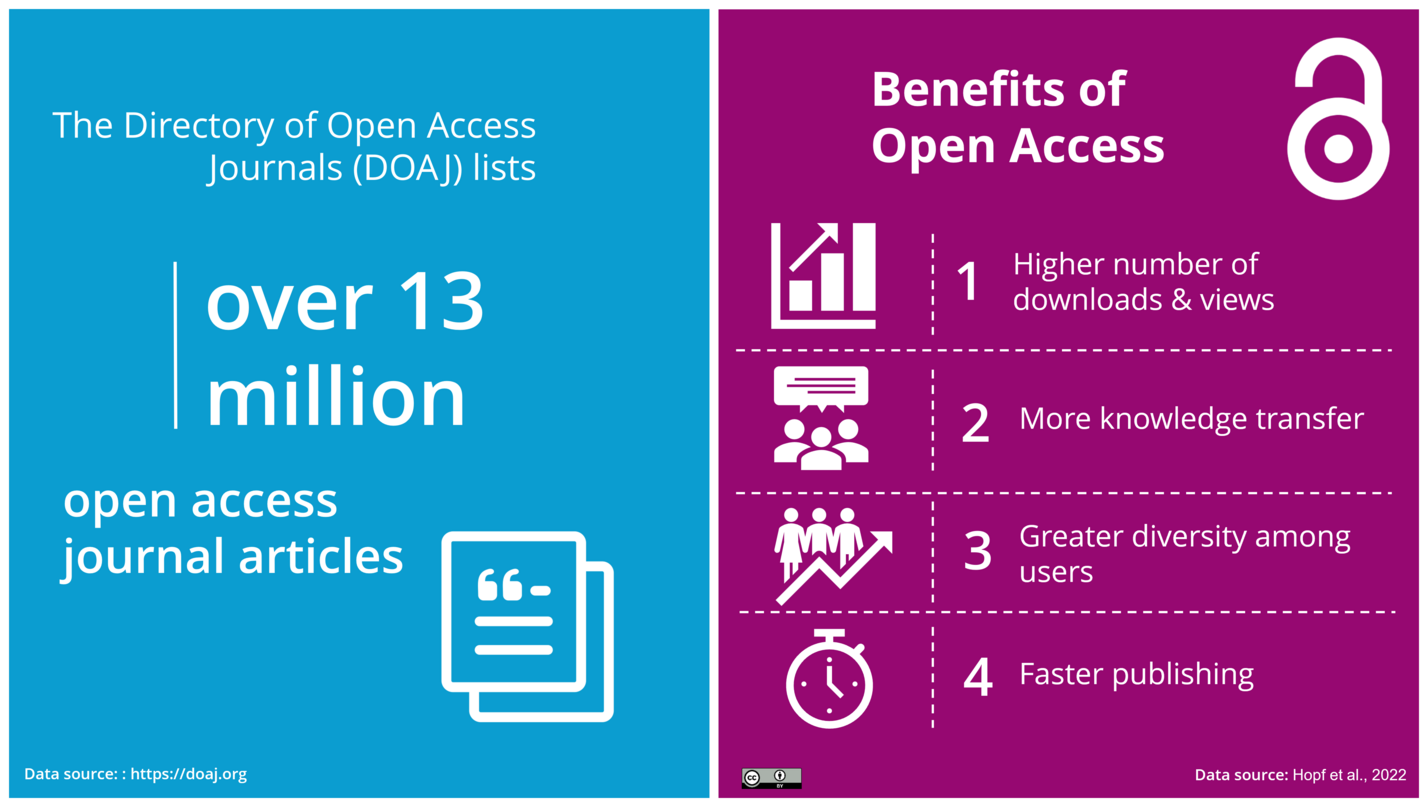
Open access journals still play quite a minor role in economics and business studies. Although their share has grown proportionally in recent years, it is still in the single-digit percentage range compared with all other journals (Laakso & Björk, 2021). There are various reasons for this, for example, the great importance of rankings, which especially favour established (subscription) journals, and, at the same time, the low level of willingness on the part of authors to publish in open access journals that levy article processing charges (APCs; Severin et al., 2018).
The following open access journals play a relevant role for economics and business research, especially in Germany (publishing institution or publisher in parentheses):
- Quantitative Economics DOAJ (Econometric Society)
- Theoretical Economics DOAJ (Econometric Society)
- Health Economics Review DOAJ (Springer)
- Journal for Labour Market Research DOAJ (IAB, Springer)
- Energy Strategy Reviews DOAJ (Elsevier)
- Environmental Research Letters DOAJ (IOP)
- Economics E-Journal DOAJ (DeGruyter)
- Jahrbücher für Nationalökonomie und Statistik (De Gruyter Brill)
- German Economic Review (Verein für Socialpolitik, De Gruyter Brill)
- Schmalenbach Journal of Business Research (VHB/Schmalenbach-Gesellschaft, Springer)
- German Journal of Agricultural Economics DOAJ (Gewisola, TIP Open Publishing)
- Wirtschaftsdienst DOAJ (ZBW, Springer)
- Intereconomics DOAJ (ZBW, Springer)
It is interesting to note that over half of the above-mentioned journals do not levy any APCs, and thus follow a diamond open access business model. Instead, the publication costs are borne by the institutions or professional associations that publish them. This may be due to the fact that, in contrast to the natural and life sciences, there is no distinctive APC culture in economics and business studies, or that the payment of APCs is less widespread in these fields (Borrego 2023).
For some years now, an increasing number of economics and business studies journals have been converted to a diamond open access model. This has been done in two different ways: first, using commercial transformative models such as “subscribe to open”, via which, for example, the publisher De Gruyter Brill has made several economics and business studies journals open access. Second, the conversion to open access has increasingly taken place in non-commercial contexts in which the title rights in a journal are not held by a commercial publisher but by a scientific institution or a professional association. One example is the Leibniz Information Centre for Economics’ (ZBW) Open Library Economics, via which economics and business studies journals are also being converted to open access.
Source: Becklas Dorow, C., Hauss, J. (2026). Funding Open Access Articles – What Are the Options?. Technische Informationsbibliothek (TIB), open-access.network. https://doi.org/10.5446/73596 (CC BY 3.0 DE)
Open Access Books
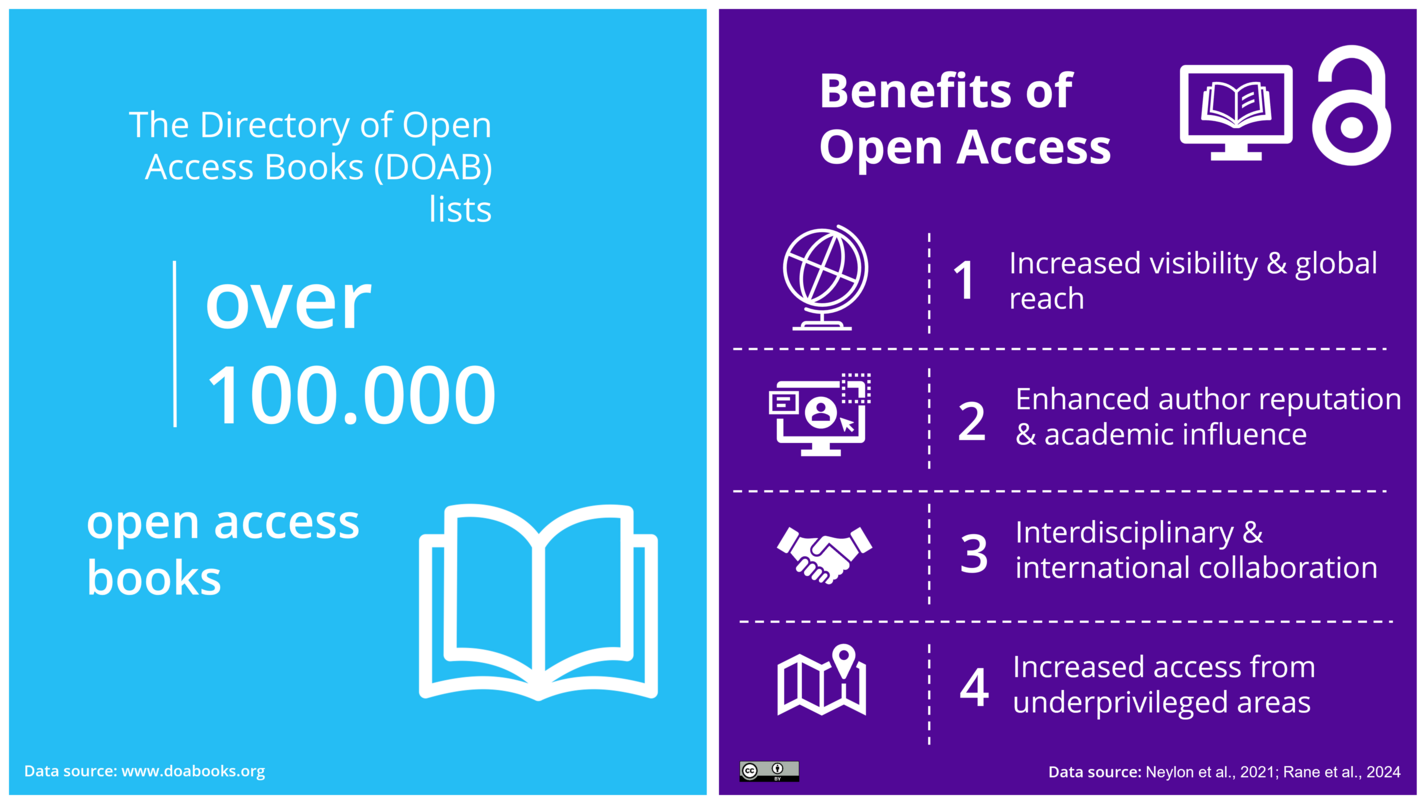
The importance of publishers’ monographs for economics and business studies research has decreased steadily in recent years. They currently play only a minor role, for example in the form of edited collections or as popular-science publications of well-known professors. Textbooks are an exception in this regard, and they are still widely used by students. However, because of their high turnover in the traditional sales model (also outside library budgets), it is difficult to transform textbooks and popular-science titles into an open access business model. The Directory of Open Access Books (DOAB) provides a good overview of the open access book segment in the areas of economics, business, management, and finance. It lists several hundred open access books from these fields.
The further financing of open access books is increasingly supported by institutional open access monograph funds, which are being established at more and more academic institutions (see also the Focus Group on Open Access Monograph Funds).
Disciplinary Repositories
There is not just “the one” disciplinary repository in economics and business studies. Rather, several relevant venues have arisen over the years that are of relevance not only, but primarily, for the culture of publishing preprints (or working papers) that exists in these disciplines.
The main repositories in economics and business studies include:
- SSRN: Although the Social Science Research Network (SSRN), which is owned by Elsevier, covers a broader range of disciplines than just economics and business studies, it is considered the largest disciplinary repository in these fields. Around 1.6 million full texts are available in open access, of which over half are from economics and business studies.
- EconStor: This publication server, which is provided by ZBW – Leibniz Information Centre for Economics, holds over 300,000 open access full texts. For the most part, these are working papers, but holdings also include conference proceedings and journal articles. EconStor publications are also indexed in RePEc as well as in Google Scholar and EconBiz.
- AgEcon Search: This disciplinary repository is operated by the University of Minnesota and funded mainly by the Agricultural and Applied Economics Association. It holds around 200,000 freely accessible full texts, mainly from the areas of agricultural and applied economics. All publications in AgEcon Search are also indexed in RePEc.
- MPRA: Hosted by Munich University Library, the Munich Personal RePEc Archive (MPRA) holds over 60,000 economics and business studies publications from all over the world. As a rule, publications are not deposited by institutions or publishers but rather self-archived by individual researchers and then released by an editorial team and indexed in RePEc.
The Open Directory of Open Access Repositories (OpenDOAR) also provides an overview of relevant repositories
Video über das Zeitveröffentlichungsrecht
Quelle: Brehm, E. (2021). Zweitveröffentlichungsrecht für Wissenschaftler*innen, open-access.network. https://doi.org/10.5446/51789 (CC BY 3.0 DE)
Practical Tip
Finding Open Access Literature (in German)
Other Useful Offerings
Many researchers in business studies and especially in economics are familiar with the platform RePEc (Research Papers in Economics) . It is a mixture of a union catalogue, a registry of institutions, and a ranking system. The circa 5 million publications listed in the union catalogue are indexed on a decentralized basis by the academic institutions and scholarly publishers themselves. With the help of automatic citation analysis and download statistics as well as information supplied by over 70,000 researchers worldwide who are registered with the RePEc author service, RePEc produces, among other things, rankings of researchers, academic institutions, and scholarly journals. The entire service is non-commercial and free of charge and is operated on a voluntary basis by various economists on distributed servers.
The search portal EconBiz, which is provided by ZBW – Leibniz Information Centre for Economics, indexes over 10 million publications; searches can be restricted to open access full texts. In addition, it offers a calendar of events (scholarly conferences, summer schools, etc.) in economics and business studies worldwide.
Open Science in Economics and Business Studies
Other aspects of open science that are of relevance to economics and business studies include, in particular, research data, which are increasingly being made available in open access and according to the FAIR Principles. In Germany, the German Data Forum (RatSWD), among others, is engaged in the further development of this area. In this pursuit, it has, for example, drawn up standards for access to research data centres. In addition, as part of the National Research Data Infrastructure (NFDI), there are also consortia from the economic sciences, for example, KonsortSWD and BERD.
ZBW – Leibniz Information Centre for Economics in particular, is also engaged in the further development of open science in economics and business studies, for example through its research activities, the annual Open Science Conference, and extensive marketing activities. Furthermore, its Open Economics Guide is a central point of reference on the topic of open science for researchers from the fields of economics and business studies.

References
- Baumann, A., & Wohlrabe, K. (2020). Where have all the working papers gone? Evidence from four major economics working paper series (CESifo Working Paper No. 8328). Center for Economic Studies and Ifo Institute (CESifo). https://hdl.handle.net/10419/219146
- Borrego, Á. (2023). Article processing charges for open access journal publishing: A review. Learned Publishing, 36(3), 359–378. https://doi.org/10.1002/leap.1558
- Laakso, M., & Björk, B.-C. (2021). Open access journal publishing in the business disciplines: A closer look at the low uptake and discipline-specific considerations. https://doi.org/10.1177/09610006211006769
- Severin, A., Egger, M., Eve, M. P., & Hürlimann, D. (2020). Discipline-specific open access publishing practices and barriers to change: An evidence-based review. F1000Research, 7, 1925. https://doi.org/10.12688/f1000research.17328.2
Content editor of this page: Olaf Siegert, Leibniz Information Centre for Economics (ZBW) (Last updated: August 2025).