
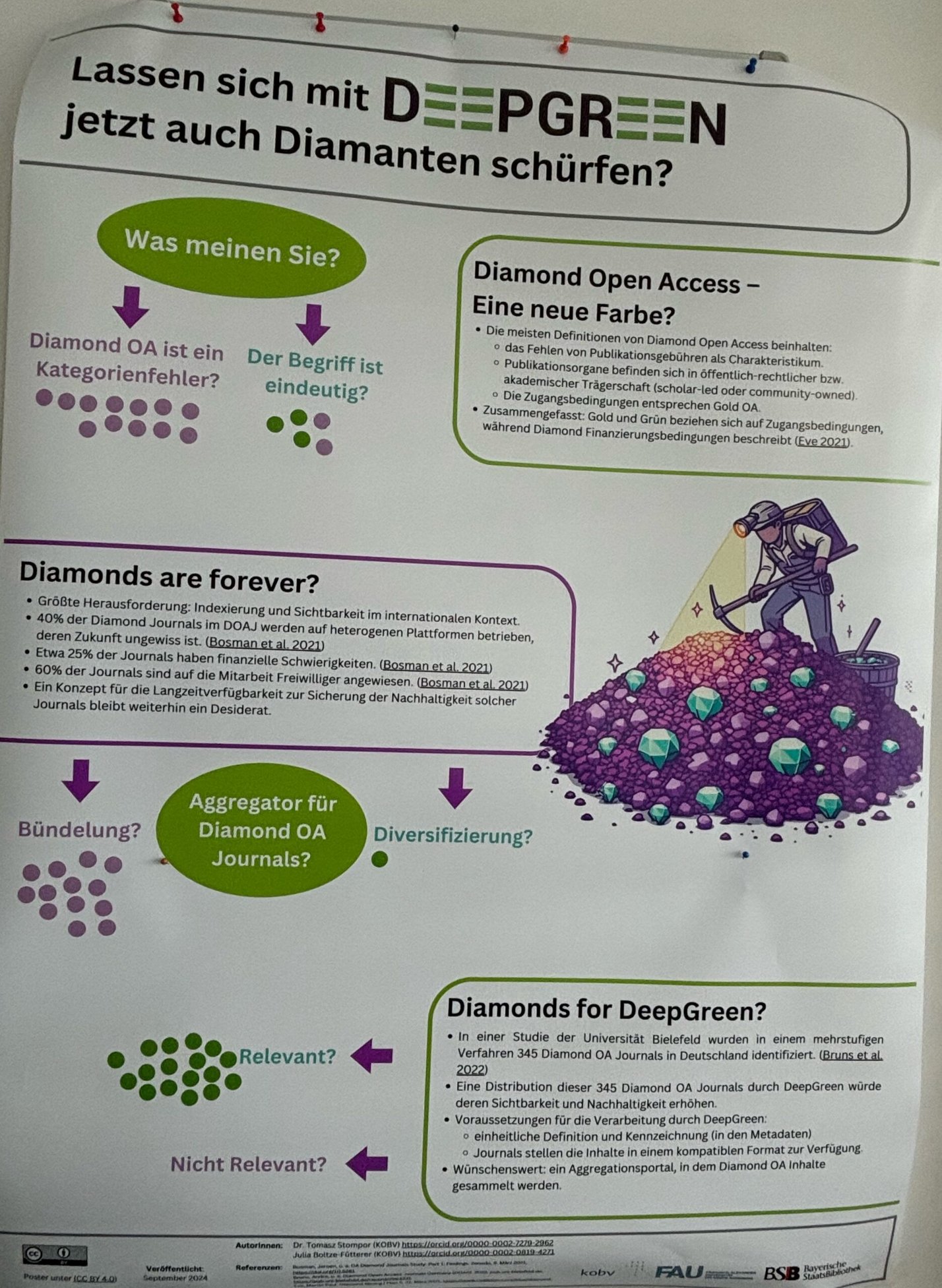
The project DeepGreen was represented with a poster at the Open-Access-Tage conference in Cologne in 2024. DeepGreen is an automated delivery service for open access articles. Based on affiliations and licensing information, DeepGreen distributes publisher content to institutional and disciplinary repositories. For this post, the two presenters of the poster, Julia Boltze-Fütterer and Tomasz Stompor, spoke to Sarah Dellmann about the questions that they had wanted to discuss with the conference attendees and the conversations that arose during the poster session.
Sarah Dellmann: Julia Boltze-Fütterer and Tomasz Stompor, during the poster session at the Open-Access-Tage in Cologne, you asked the attendees about the needs that can be derived from the currently much-discussed developments around diamond open access. The first question was: Is the concept of diamond open access defined clearly enough? Judging by the Post-it notes left on the poster, most people don’t seem to think that this is the case.
Tomasz Stompor: The first section of the poster focuses on the question of the extent to which the definition of diamond open access is coherent and whether the concept might be a category error. The main feedback was that the category “diamond open access” describes funding arrangements, whereas the two established categories in the library world, “gold open access” and “green open access”, describe access arrangements. What we also found interesting was that it was the question as to whether the concept was unclear that got many people thinking who had previously used the term unquestioningly. However, a lot of attendees found the problematisation that we had formulated in the question (“Is ‘diamond open access’ a category error?”) plausible.
SD: The question as to what “diamond open access” describes and what it does and does not include is the subject of lively discussion among infrastructure staff and research funders. Why is the definition important for you as service providers?
TS: If “diamond open access” doesn’t merely describe an access regime but rather a business model, then it doesn’t reflect the complexity of existing business models. The problem is that there are very many borderline cases and exceptions where the current definitions of diamond open access do not apply. They include, for example, the journals of the American Chemical Society (ACS) and the journal of the German Association for American Studies (GAAS), Amerikastudien.1 In his keynote at the Open-Access-Tage 2024, Niels Taubert described terms such as “scholar-led” and “scholar-owned” as “affect laden”. These terms express either frustration with large, for-profit publishers or a pipe dream, but they are not operationalisable concepts that could be used to categorise or measure something. And that, of course, makes things difficult for the further development of our service.
SD: Is the lack of clarity a hindrance to your work?
JBF: Yes and no. We haven’t yet reached the stage of operationalising the procedure for integrating diamond open access content into DeepGreen. We are still in the research and conception phase as far as the inclusion of diamond open access content is concerned. At DeepGreen, we are of course aware of the discussions about diamond open access and the desire on the part of libraries to expand activities in this area, and we are asking ourselves what this development might mean for a service like DeepGreen. At the moment, that is still an open question. What is clear, however, is that, as the process progresses, we will have to agree on what falls into the diamond open access category – and what doesn’t.
SD: What steps have you taken in the research and conception phase?
JBF: First, we determined the demand for open access articles: At the BiblioCON conference in Hamburg in 2024, we asked our participating repositories whether they would welcome a service for the delivery of diamond open access articles. The feedback was positive. However, the prerequisite for the processing of diamond open access articles by DeepGreen would be that the data are available in a good format. Unfortunately, this has often not been the case. Whether a solution to this problem for the diamond open access journals operated with Open Journal Systems (OJS) software can be found via an OJS plugin that delivers content to an aggregator and performs mapping is something we still have to think about.
TS: Therefore, we wanted to know whether this desire for bundling was shared by our users at all. Most of the Open-Access-Tage attendees we talked to at the poster session shared the desire for greater bundling and standardisation and emphasised that this would have a quality-assurance function.
SD: Open-Access-Tage attendees are mainly library staff. However, we have also found that editors of journals in small disciplines often perceive standardisation as a threat. It’s not always easy to convey that technical standardisation is a quality feature and doesn’t mean the loss of format diversity or even the standardisation of content.
TS: Exactly. That brings us to the second question on the poster, where we asked about the indexing and long-term availability of diamond journals. This question relates to the diverse landscape of diamond open access journals and whether their visibility could be increased through bundling and standardisation, or whether such measures might limit this diversity.
SD: What questions are you asking yourselves in this process?
JBF: One major challenge is that diamond open access journals are often small, whereas DeepGreen is a service that delivers mass. This critical mass is necessary. That was the experience of our colleagues in the Swiss project GOAL, who found that the effort and the results were not worthwhile because the mass was too small for automation. So, we need bundling in order to be able to economically integrate diamond open access content into DeepGreen. We came up with the idea of a diamond open access aggregator. Hence the question on the poster about the benefits of such an aggregator. However, aggregation requires bundling and standardisation.
TS: … and these features are not particularly pronounced among diamond open access journals, as the OA Diamond Journals Study (Bosman et al., 2021) showed. Journals that do not meet these quality criteria would of course continue to exist, but they might not be aggregated. Clear criteria for quality assurance are therefore important.
SD: How do you envision aggregation?
TS: That’s the big question. It’s clear that not every journal will be expected to individually deliver its content to somewhere. That won’t work. At present, we are thinking about an OJS plugin that delivers metadata to a central infrastructure, a registry, as is currently being developed, for example, in the CRAFT-OA project. Another starting point is the list of diamond open access journals hosted in Germany (Bruns et al., 2022). Would the 345 diamond open access journals on this list be relevant for the DeepGreen participants? This question was answered with a resounding yes.
SD: What challenges and desiderata are there, and what tasks might have to be performed by third parties?
TS: Another issue that is obvious but that we as DeepGreen cannot resolve is the need for technical support expressed by editors of small, publisher-independent journals. Advice alone is not enough. What is really needed here is support in implementing technical, library, and publishing standards. Several colleagues who work in specialised information services (FIDs) have told us about journals that are relevant in terms of content but whose technical set-up is poor. That is a shame, and it represents a service gap. A journal service organised by libraries would be a remedy.
JBF: DeepGreen began by focussing on green open access content, but the service is dependent on the licensing landscape, which is in flux. For example, generally speaking, Alliance licences and national licences – in other words classical self-archiving and green open access content – are decreasing in volume, whereas gold open access content is increasing. Thus, the development of diamond open access is an opportunity for us to adapt to new needs in order to deliver a service that is helpful for our users – and remains so under new circumstances.
1 The ACS is a professional society that also publishes closed access journals. The GAAS is also a professional society; it publishes its open access journal Amerikastudien with a for-profit publisher.
The cover image is AI-generated.
Suggested citation
Boltze-Fütterer, J., Dellmann, S., & Stompor, T. (2025). DeepGreen und Diamond. open-access.network. doi.org/10.64395/0xtjv-k2x10.
This article is licensed under the Creative Commons Attribution 4.0 International Licence (CC BY 4.0).


