
Open Access in Psychology
In line with the general trend, open access has also gained ground and further established itself in psychology, albeit via various routes. In Germany, the largest professional association in psychology, the German Psychological Society (DGPs), expressed its support for open access very early on. For example, as far back as September 2004, the general assembly of the DGPs endorsed the Berlin Declaration on Open Access to Knowledge in the Sciences and Humanities, which the DGPs formally signed in 2017.
In addition, the Leibniz Institute for Psychology (ZPID) in particular is committed to open access in psychology. In 2012, it launched PsychOpen GOLD, an open access publishing platform for psychology on which 14 open access psychology journals are currently provided. A distinctive feature of the journals published by PsychOpen GOLD is that they use a diamond open access business model. Thus, all content is made freely accessible to readers worldwide at no charge to authors or editors. Furthermore, one of PsychOpen GOLD’s primary goals is to strengthen open science practices in psychology and enhance the international visibility of European psychological research. Besides PsychOpen GOLD, the ZPID offers free access to a range of other information products for psychology (see the "Open Science" section below).
By contrast, the internationally influential American Psychological Association (APA), the largest psychological association in the world, was for a long time quite unreceptive to open access. For example, in September 2007, the then President of the APA, Sharon Stephens Brehm, warned that the existing system of scientific publishing should be changed only with caution (Stephens Brehm, 2007). This reticence about open access is presumably due not least to the fact that, as a commercial publisher, the APA publishes around 90 scholarly journals of psychology. However, all APA subscription-based journals now offer a hybrid open access option whereby authors can make individual contributions freely accessible by paying an article processing charge (APC). However, this does not mean that these contributions can be published under an open content licence, for example a Creative Commons (CC) licence. The APA has concluded open access agreements (also known as “read and publish agreements”) with several organizations worldwide. Authors affiliated to institutions participating in these agreements do not have to pay APCs. In addition, all APA journal authors have the option of self-archiving a copy of their author accepted manuscript (AAM) in a repository (green open access) and of making it publicly available under an open content licence.
In psychology, scholarly literature can be found largely in journals. By contrast, books or conference proceedings play a lesser role. Open access to scholarly books in psychology is still in its infancy.
Purely open access journals are still the exception in psychology. In September 2025, a search conducted in OpenAlex for sources with the keyword “psychology” in the title yielded 1,046 journals, of which 26.2% (274) were classified as open access and 11.7% (122) met the narrower criteria for inclusion in the Directory of Open Access Journals (DOAJ). In an earlier study based on a sample of Web of Science articles published between 2009 and 2015, Piwowar et al. (2017, 2018) found that 4.7% of the articles in psychology were published in purely open access journals (gold open access). However, as many journals in psychology offer authors at least an open access option (hybrid model), the share of actually freely available psychology journal articles is probably higher. This is also indicated by a study conducted by Hardwicke et al. (2022), who examined transparency measures in the psychology literature and found an open access rate of 65% for the N = 250 articles included in a random sample of psychology articles published between 2014 and 2017.
Open Access Journals
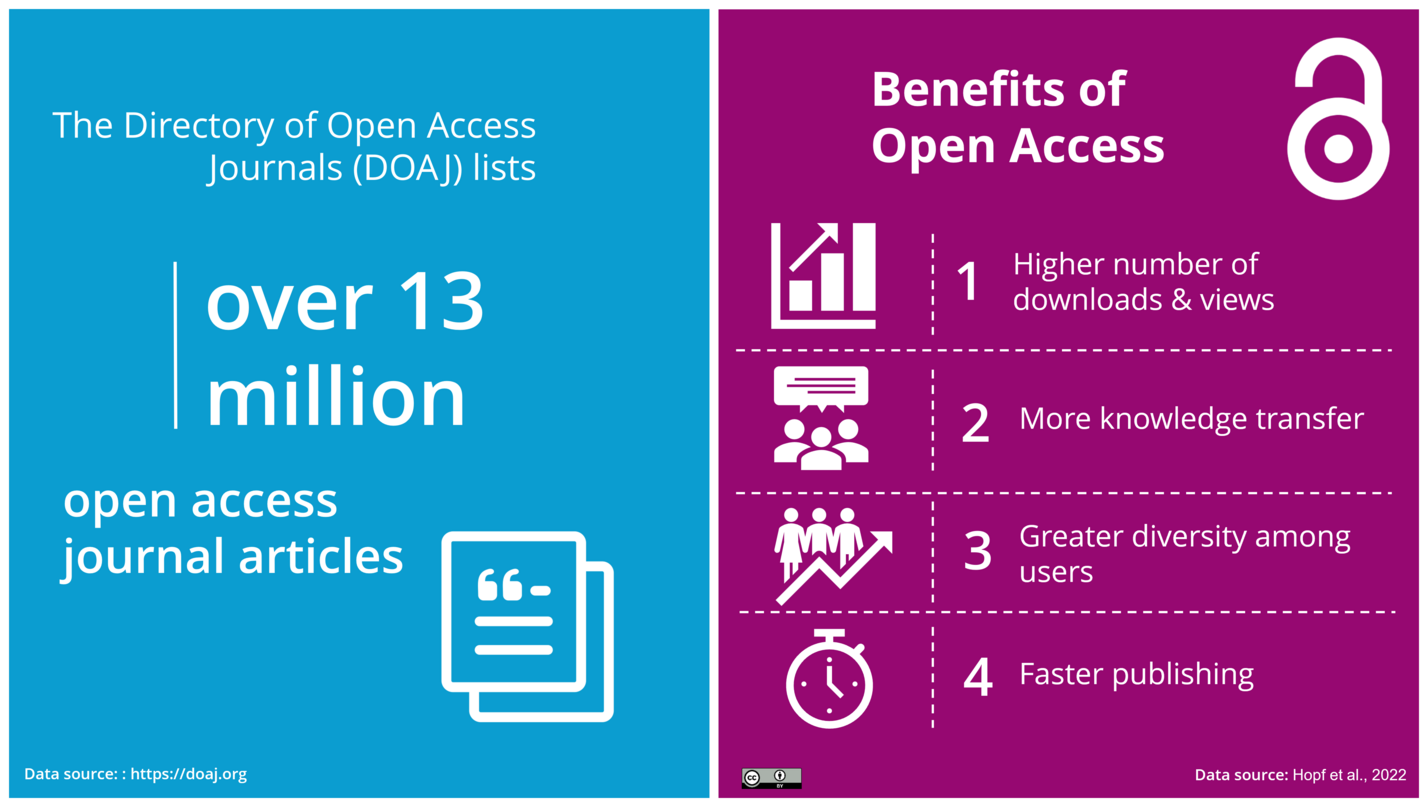
As of August 2025, the aforementioned Directory of Open Access Journals (DOAJ) itself listed 1,838 entries under the keyword Psychology. Many of the purely open access journals can traditionally be found on scholarly, non-commercial platforms of professional associations, research institutions, universities, or specialised information centres. However, as author-funded business models are growing in popularity, purely open access journals are increasingly being provided by traditional scholarly publishers and new commercial open access publishers.
Important open access journals in psychology include:
- Advances in Cognitive Psychology DOAJ
- Collabra Psychology DOAJ
- Europe's Journal of Psychology DOAJ
- Frontiers in Psychology DOAJ
- Judgement and Decision Making DOAJ
- Social Cognitive and Affective Neuroscience DOAJ
Some of the above-mentioned journals have been published open access for many years now and do not levy any article processing charges (APCs) (Europe's Journal of Psychology, Judgement and Decision Making). Among the open access journals that do charge their authors a fee to have their research articles published, this fee ranges from a few hundred (e.g. Advances in Cognitive Psychology) to several thousand euros/dollars (e.g. Frontiers in Psychology) and is payable before publication. Frontiers in Psychology is an example of a mega-journal that is published by a commercial open access publisher and publishes several thousand articles per year.
As of August 2025, the most important psychology publisher in the German-speaking area, Hogrefe, had four purely open access journals in its portfolio (European Journal of Psychology Open, Sports Psychiatry, Psychological Test Adaptation and Development, Rorschachiana). For all the other journals in its portfolio, it offers authors the option of publishing their articles open access against payment of an APC (hybrid model). Hogrefe has concluded transformative agreements with institutions in Germany and Switzerland, whereby open access publication charges are consortially funded. Authors affiliated to participating research institutions can thus publish open access without having to pay individual APCs.
In addition to these traditional journals, other types of publication are also gaining in importance. They include, for example, the Peer Community in (PCI) platforms, which offer free peer-reviews of preprints and registered reports for a wide range of disciplines. Registered reports are an alternative publishing format to the classical journal article. Before a study is conducted, a “Stage 1 manuscript” comprising research questions, theoretical background, hypotheses (if applicable), methods, and any necessary preliminary data is submitted to a journal or to PCI Registered Reports (PCI RR), where it undergoes peer-review. If successful, authors receive “in-principle acceptance” and thus have the assurance that their study will be published irrespective of the results. After in-principle acceptance, the authors conduct the study and complete the manuscript by adding the Results and Discussion sections (Stage 2 manuscript). PCI RR has agreements with various journals (so-called “PCI-friendly journals) whereby articles reviewed and accepted in principle at PCI RR can be published after undergoing a shortened peer-review (PCI-friendly journals) or without having to undergo peer-review at all (in Peer Community Journal). Registered reports are not published solely in open access, but both modes are often combined. PCI RR and PCI Psychology play an increasingly important role in psychology.
Source: Becklas Dorow, C., Hauss, J. (2026). Funding Open Access Articles – What Are the Options?. Technische Informationsbibliothek (TIB), open-access.network. https://doi.org/10.5446/73596 (CC BY 3.0 DE)
Open Access Books
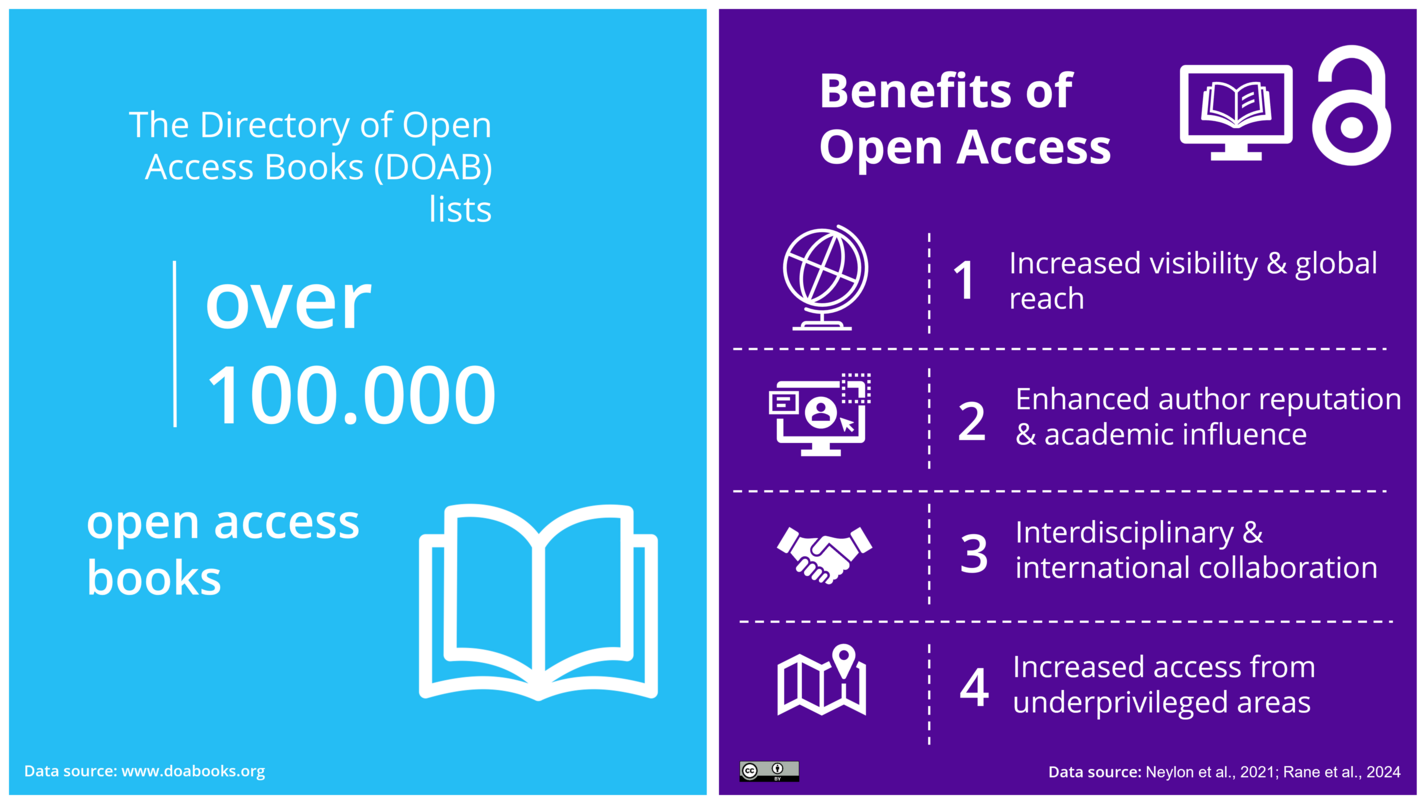
As of August 2025, the Directory of Open Access Books listed 738 titles under Psychology, and the online library of open access books OAPEN listed 21,855 titles under Psychology. As scholarly literature in psychology is largely found in journals, books and conference proceedings play a minor role. Nonetheless, the number of open access books has been increasing steadily in recent years.
Disciplinary Repositories
Important disciplinary repositories in psychology include:
- PsychArchives – one of the few open access repositories worldwide that specialise in psychology. In addition to the actual manuscripts, it also contains in many cases supplementary material (e.g. data and code).
- PsyArXiv – contains preprints from psychology
- Social Science Open Access Repository (SSOAR) – contains documents from the social sciences, some of which are also assigned to psychology.
Green open access – that is, the self archiving of preprints and post-prints – is now widespread in psychology and is permitted by many publishers.
An overview of relevant repositories is also provided by the Open Directory of Open Access Repositories (OpenDOAR).
Video über das Zeitveröffentlichungsrecht
Quelle: Brehm, E. (2021). Zweitveröffentlichungsrecht für Wissenschaftler*innen, open-access.network. https://doi.org/10.5446/51789 (CC BY 3.0 DE)
Practical Tip
Open-Access-Literatur finden [Finding Open Access Literature] (available only in German)
Other Useful Offerings
As yet, there are no databases and search engines that index only open access documents from psychology. However, with PsychPorta there is a large, freely accessible psychological reference database that also provides links to full texts and allows users to filter search results specifically by open access content. PsychPorta comprises records of journal articles, books and book chapters, intervention programmes, research data, and psychodiagnostic test instruments from all areas of psychology.
Open Science in Psychology
Ever since Ioannidis (2005) questioned the validity of most published research findings, and in view of the large number of failed attempts to replicate previously significant effects (e.g. Open Science Collaboration, 2015), vehement discussions on the reliability of published research findings have been taking place in many scholarly disciplines under the heading “replication crisis”. According to the criticism of scientific practice, the low reproducibility could be an indication of a high rate of false-positive results. Potential causes of this (e.g. p-hacking or HARKing) are often subsumed under the rubric "questionable research practices".
In reaction to this, there has been an increase in the importance of open science (e.g. Munafò et al., 2017), an umbrella term for a wide variety of practices aimed at making the research process more transparent and thus more reproducible. Open science also aims to make research accessible to more people. Important open science practices in psychology include, for example, the preregistration of studies (i.e. the recording and publication of research plans before the beginning of a study/the data analysis in order to transparently specify a priori what is planned), open material, and open data (i.e. the sharing of research materials and data in order to make findings transparent and reusable). As there are diverse and changing positions on open science within psychology, the extent of the spread of its constituent elements varies (Spinath, 2021).
There are various offerings in psychology that are in the spirit of the open science idea:
RDC at ZPID – The Research Data Centre (RDC) at ZPID makes psychological research data available for reuse. Provided by the Leibniz Institute for Psychology (ZPID), and accredited by the German Data Forum (RatSWD), it documents, archives, and publishes research data from all areas of psychology; it is currently the only research data centre specialising in psychology.
Open Science Framework – The Center for Open Science, which operates the Open Science Framework (OSF), a platform for sharing documents, data, scripts, etc., is one of the most committed advocates of open access, also in psychology. Although this initiative is transdisciplinary, it has a strong psychological foundation.
Open Test Archive – This archive, which is also provided by the Leibniz Institute for Psychology (ZPID), makes open access test instruments available for research and teaching.
PsychAuthors – This freely accessible database contains profiles and publication lists of authors in psychology from the German-speaking area.
Link Collection of the German Psychological Society (DGPs) – practical resources for research and teaching on the topic of open science
In addition, there are numerous open science initiatives at the psychological institutes and faculties of various universities in Germany. Most of these initiatives have come together in the Netzwerk der Open-Science-Initiativen in Deutschland (NOSI).

References
- Hardwicke, T. E., Thibault, R. T., Kosie, J. E., Wallach, J. D., Kidwell, M. C., & Ioannidis, J. P. A. (2021). Estimating the prevalence of transparency and reproducibility-related research practices in psychology (2014–2017). Perspectives on Psychological Science, 17(1), 239–251. https://doi.org/10.1177/1745691620979806
- Ioannidis, J. P. A. (2005). Why most published research findings are false. PLOS Medicine, 2(8). https://doi.org/10.1371/journal.pmed.0020124
- Munafò, M. R., Nosek, B. A., Bishop, D. V. M., Button, K. S., Chambers, C. D., Percie du Sert, N., Simonsohn, U., Wagenmakers, E.-J., Ware, J. J., & Ioannidis, J. P. A. (2017). A manifesto for reproducible science. Nature Human Behaviour, 1. https://doi.org/10.1038/s41562-016-0021
- Open Science Collaboration. (2015). Estimating the reproducibility of psychological science. Science, 349(6251). https://doi.org/10.1126/science.aac4716
- Piwowar, H., Priem, J., Larivière, V., Alperin, J. P., Matthias, L., Norlander, B., Farley, A., West, J., & Haustein, S. (2017). Data from: The state of OA: A large-scale analysis of the prevalence and impact of Open Access articles. Zenodo. https://doi.org/10.5281/zenodo.1041791
- Piwowar, H., Priem, J., Larivière, V., Alperin, J. P., Matthias, L., Norlander, B., Farley, A., West, J., & Haustein, S. (2018). The state of OA: A large-scale analysis of the prevalence and impact of Open Access articles. PeerJ, 6. https://doi.org/10.7717/peerj.4375
- Spinath, B. (2021). Zur Lage der Psychologie. Psychologische Rundschau, 72(1), 1–18. https://doi.org/10.1026/0033-3042/a000521
- Stephens Brehm, S. (2007). Open access: A thorny debate. Monitor on Psychology, 38(8). https://www.apa.org/monitor/sep07/pc
Content editors of this page: Dr Katarina Blask, Dr Lisa Spitzer and Dr Gerrit Fröhlich, Leibniz Institute for Psychology (ZPID) (Last updated: September 2025).