
Hi open-access.network owner, Your posts are always well-written and easy to understand.
CODRIA, PLATO, and KOALA: Studies on Diamond Open Access Journals and Funding Models in Germany and Switzerland
"Managing the Open Access Transition in a Sustainable Way. Diamond Open Access as an Alternative" is the title of a new series of events on diamond open access hosted by open-access.network. The first event in this series took place on 20 September 2023. It focused on studies on diamond open access journals in Germany and Switzerland and experiences with the consortial funding of such publications.
Diamond open access – also known as platinum open access – enables open access publishing without author-side fees. It has been discussed intensively recently as an alternative to open access based on article processing charges (APCs) or book processing charges (BPCs).
At European level, cOAlition S, OPERAS, Science Europe, and the French National Research Agency (ANR) adopted the Action Plan for Diamond Open Access in 2022. The first Diamond Open Access Conference took place in Zadar (Croatia) in summer 2022. The second conference, the Global Summit on Diamond Open Access, followed in Toluca (Mexico) in October 2023. As early as 2021, Science Europe and cOAlition S published the Diamond Open Access Journals Study, an inventory and examination of diamond open access journals, their funding models, challenges, and potential (Bosman et al., 2021; Becerill et al., 2021).
The German projects KOALA (Establishing Consortial Open Access Solutions) and CODRIA (Community-Driven Open Access Journals Between Scientific and Resource-Related Requirements) and the Swiss project PLATO (Platinum Open Access Funding) have addressed the publishing conditions, potential for improvement, and possible models for diamond open access journals.
At the information event on 20 September, Daniela Hahn (University of Zurich) and Nils Taubert (Bielefeld University) reported the findings of the research projects PLATO and CODRIA, respectively. Then, Alexander Pöche (Leibniz Information Centre for Science and Technology [TIB] in Hanover) presented the project KOALA and outlined experiences gained from organising and managing funding consortia for diamond open access publications.
Diamond Open Access Journals in Germany and Switzerland
The findings of the investigations conducted within the framework of CODRIA (Bruns et al., 2022; Taubert et al., 2023) and PLATO (Hahn et al., 2022) are similar to those of the Diamond Open Access Journals Study (Bosman et al., 2021) – namely, that diamond open access journals are an important part of the scholarly communication landscape, especially in the social sciences and the humanities; that these journals are rather small, usually publishing no more than 25 articles a year; and that they rely on very different sources of funding, with many of them struggling with an uncertain financial situation. Further, the findings of CODRIA and PLATO provide important insights into the strategies that diamond open access journals use to manage scarce resources, and they contribute to clarifying the respective needs.
CODRIA, which was funded by the German Federal Ministry for Education and Research (BMBF; project term: 1.2.2021–31.1.2023), mapped the diamond open access journal landscape in Germany. Within the framework of a bibliographic analysis, a list of 458 diamond open access journals was compiled (see Bruns et al., 2022). Many of these journals are rather small – in 2021, only 16 contributions were published per journal, on average. However, there are large differences in this regard: in 2021, the journal with the highest output published 288 articles.
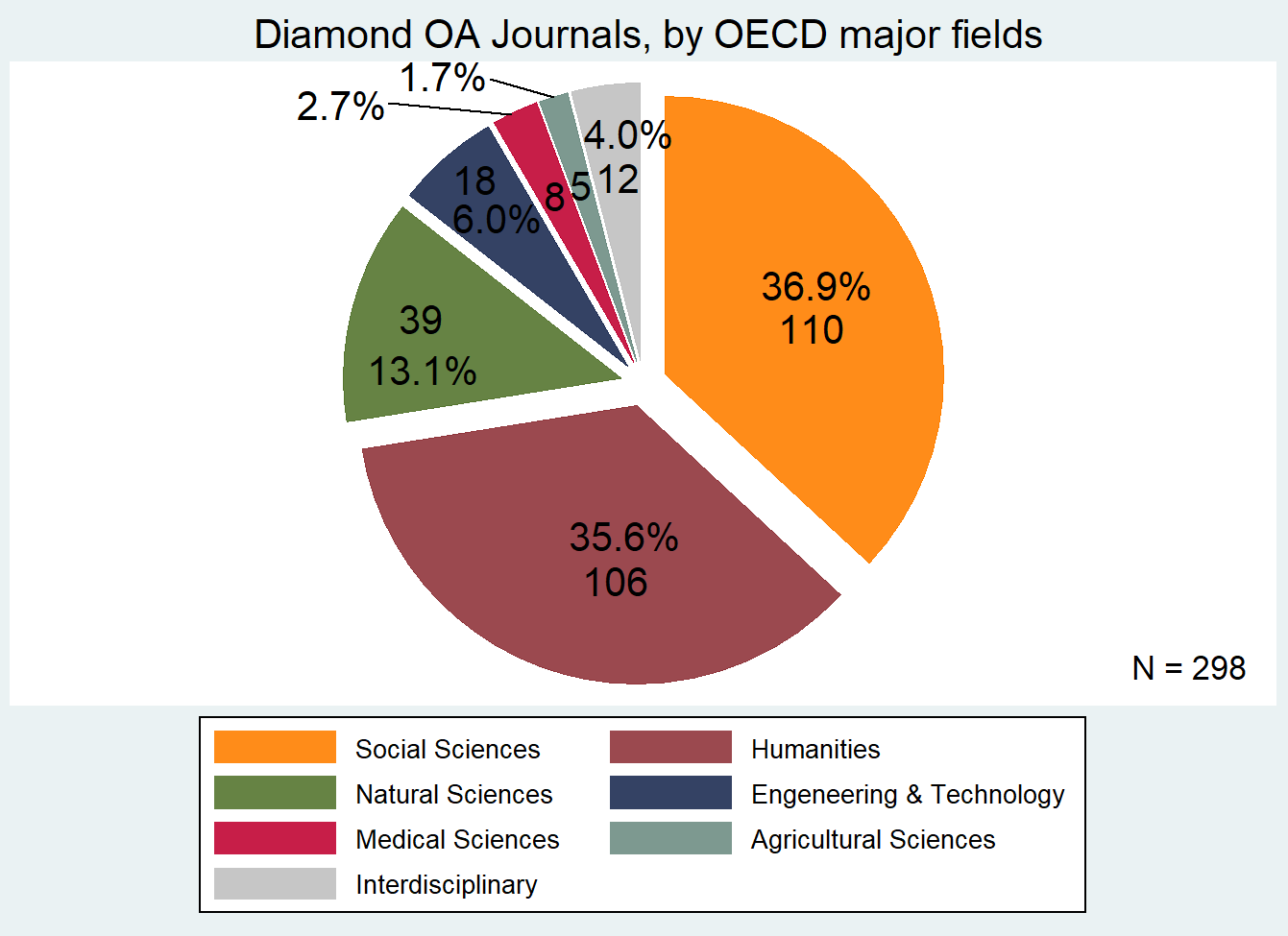
With a share of 72.5%, the humanities and social sciences are strongly over-represented in the list of diamond open access journals in Germany compiled within the framework of CODRIA. Only around 13% of these journals have a natural sciences orientation, and only 6% have an engineering and technology orientation (see Figure 1).
The CODRIA project team explored the bibliometric findings in greater depth in a qualitative study and found that many journals operated on the basis of mixed economies: whereas some tasks were remunerated, others were organised on a voluntary basis. What all the surveyed journals had in common was that they did not operate on a financially sound basis. Rather, they were frequently dependent on locally available funds or time-limited project funding. One strategy for coping with this may be to distribute tasks among a large number of volunteers. However, the circle of committed supporters is often small, and key tasks depend on the commitment of individual persons. In his presentation at the information event on September 20, Niels Taubert therefore concluded that sustainable funding was needed to create a sustainable business basis for diamond open access journals.
Daniela Hahn, project lead of PLATO, arrived at the same conclusion in her presentation. PLATO is a collaborative project on the part of six Swiss universities. In addition to mapping the Swiss diamond open access journal landscape and examining the challenges these journals face, the project aims to develop sustainable funding strategies for scholar-led diamond open access publishing in Switzerland.
In the first project phase, PLATO – like CODRIA – set out to make an inventory of all diamond open access journals in Switzerland and to examine their perspectives and challenges. Ultimately, PLATO compiled a list of 235 Swiss diamond open access journals. In line with the findings of CODRIA, the journals examined by PLATO were for the most part small – publishing less than 25 articles per year – and the humanities and social sciences accounted for the largest share (67.3%).
In contrast to CODRIA, the PLATO study also asked about publisher type and funding mechanisms: Over half of the inventoried journals are published by/at higher education institutions (46.4%) and academic societies (16.6%), whereas only 15.7% are published by for-profit publishers. Like CODRIA, PLATO found that diamond open access journals had a broad range of funding sources. This mixed funding from many small pots is often necessary to secure the continued existence of the journal, as many journals find it hard to organise sustainable funding.
In the second project phase, PLATO aims to develop a funding model for diamond access journals. The challenge here is to identify partially hidden costs and to research infrastructure costs. The latter vary depending on whether the journal is hosted in-house or on an external platform, free of charge or for a fee. Within the framework of PLATO, six samples were drawn. The results of the analyses showed that the median total journal costs were 15,000 Swiss francs (15,600 euros) per annum.
Enabling Sustainable Diamond Open Access
From PLATO's perspective, strategic, organisational, and financial questions arise in relation to the future of diamond open access funding in Switzerland: Strategically, diamond open access is to be integrated into the revised national open science strategy of swissuniversities, the umbrella organisation of the Swiss universities. However, it is unclear how the challenge of funding diamond open access can best be overcome. Besides consortial models (joint funding by several scholarly libraries), the establishment of a national capacity centre would be a possible model. Financially, clarification is needed as to how the costs of diamond open access will develop in the future. In the course of the general development towards open science, it may – despite tight budgets – be worthwhile investing in models that enable sustainable publishing in the long term.
The development of such a model was the aim of the BMBF-funded project KOALA (Establishing Consortial Open Access Solutions), which was conducted jointly from 2021 to 2023 by the German National Library of Science and Technology (TIB) in Hanover and the Communication, Information, Media Centre (KIM) at the University of Konstanz. At the event on 20 September, Alexander Pöche presented the experiences from the KOALA model from a consortia-management perspective.
KOALA succeeded in organising a total of three funding consortia for diamond open access journals and book series. When doing so, KOALA met with strong interest both from the journals and from the scholarly libraries. In general, there is great interest in supporting consortial models. Model contracts and fee models developed and applied within the framework of KOALA are accepted by the community.
At the same time, KOALA revealed a number of challenges that must be further considered in the future. For example, at least in the funding rounds to date, the organisational burden was relatively considerable, and the question is how it could be reduced in future. There is scope for easing the burden by adapting the acquisitions procedures at the libraries, for example in the form of fixed workflows. Dedicated budgets for diamond access would be another possible way of easing the burden, as they would make acquisition decisions in the area of diamond open access easier. And, thirdly, it might be possible to tap potential for simplification when putting packages together. Moreover, for the further development and maintenance of consortia in the area of diamond open access, it is important to recruit additional institutions to manage consortia. International collaborations may also offer potential for the further development of diamond open access consortia in the future. The follow-up project, KOALA-AV, which started in late 2023, is also dedicated to anchoring and expanding consortial open access solutions. It is being conducted at the TIB in Hanover and the University of Konstanz and will run until 2023. The internationalisation of consortia is also on the agenda.
Matters discussed at the event on 20 September included, for example, the question of who decides on participation in an open access consortium and under what conditions. Event participants pointed out that in addition to the acquisitions departments, subject specialists were also addressees. They noted that besides the disciplinary relevance of the publications, the extent of their use and the funds available at the libraries were also decisive factors. However, usage was difficult to prove because, for data minimisation reasons, many journals do not evaluate website access data. One reason for deciding against participation in open access consortia was often that money was simply lacking at the institution, and that otherwise other products would have to be removed from the portfolio, which would be difficult to convey. By contrast, setting aside funds to finance diamond access when planning the budget might be an instrument with which the funding of such models could be facilitated in the future.
Outlook
The event series "Managing the Open Access Transition in a Sustainable Way. Diamond Open Access as an Alternative" is continuing. You can find announcements concerning upcoming events here: https://open-access.network/fortbilden/workshops/informationsreihe-die-open-access-transformation-nachhaltig-gestalten-diamond-oa-als-alternative
In addition, within the framework of open-access.net there are plans to produce a guide about new forms of open access funding, in which the event series on diamond open access will also be documented.
References
Becerill, A., Bjørnshauge, L., Bosman, J., Frantsvåg, J. E., Kramer, B., Langlais, P.-C., Proudman, V., Redhead, C., Torny, D., & Mounier, P. (2021) OA Diamond Journals Study. Part 2: Recommendations. Zenodo. http://doi.org/10.5281/zenodo.4562790
Bosman, J., Frantsvåg, J. E., Kramer, B., Langlais, P.-C., & Proudman, V. (2021). OA Diamond Journals Study. Part 1: Findings. Zenodo. http://doi.org/10.5281/zenodo.4558704
Bruns, A., Cakir, Y., Kaya, S., Beidaghi, S., & Taubert, N. C. (2022, August 31). Diamond Open Access Journals, Germany (DOAG) (Version 1.1.). Bibliometrics Working Group at the Institute for Interdisciplinary Studies of Science, Bielefeld University. https://doi.org/10.4119/unibi/2965484
Hahn, D., Hehn, J., Hopp, C., & Pruschak, G. (2022, December). Mapping the Swiss landscape of diamond open access journals: The PLATO study on scholar-led publishing. Zenodo. http://doi.org/10.5281/zenodo.7461728
Taubert, N., Sterzik, L., & Bruns, A. (2023, June 22). Mapping the German open access journal landscape. ArXiv. https://arxiv.org/pdf/2306.13080.pdf
Zitiervorschlag
Benz, M. (2023). Codria, Plato und Koala. Diamond Open Access-Zeitschriften und Finanzierungsmodelle in Deutschland und der Schweiz. open-access.network. doi.org/10.64395/b7qeq-c5f76.
This article is licensed under the Creative Commons Attribution 4.0 International Licence (CC BY 4.0).

